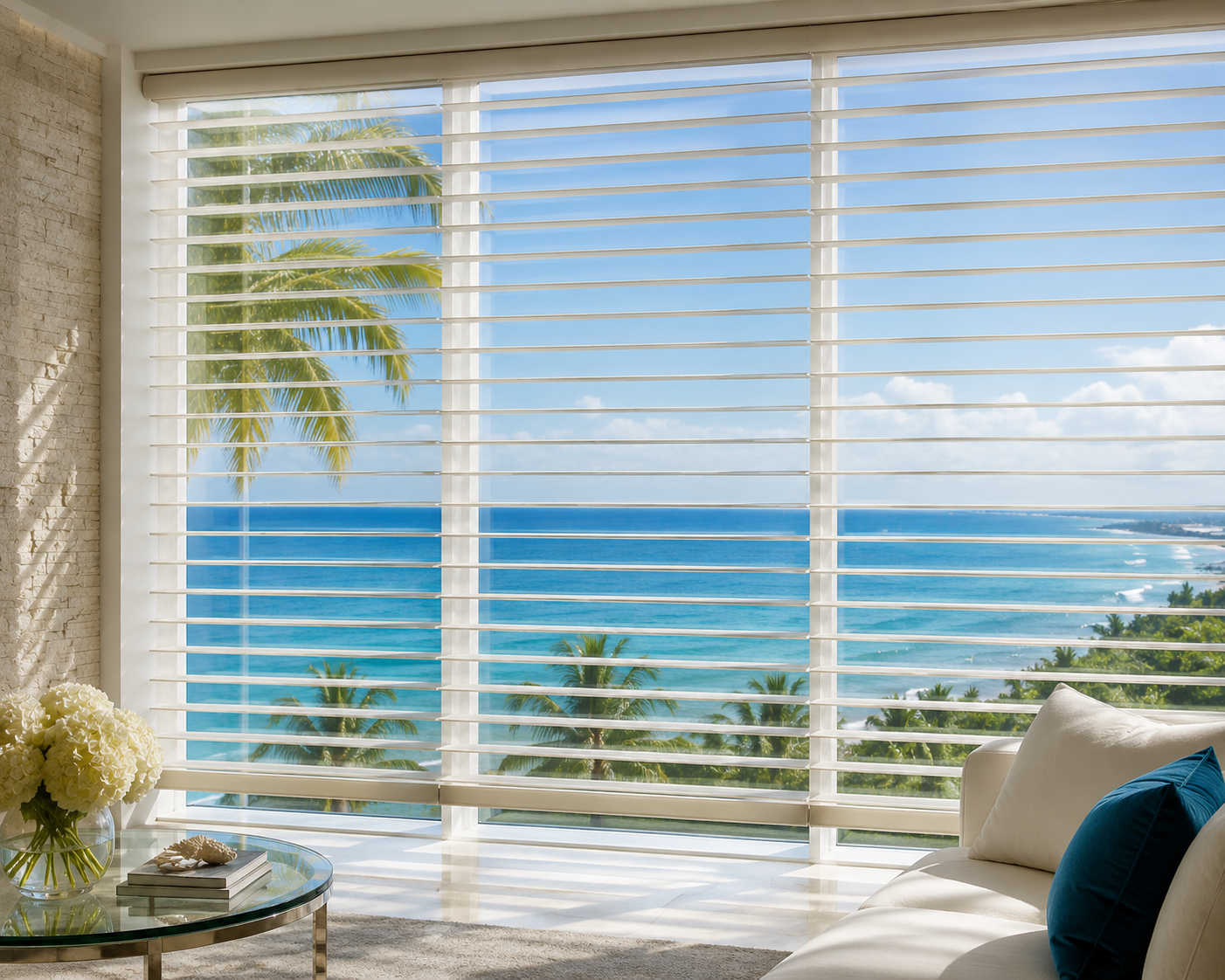
Shangri-La Shades in Miami and South Florida
Shangri-La shades — also written Shangri La shades, Shangrila shades or simply sheer horizontal shades — suspend soft horizontal fabric vanes between two layers of sheer fabric. Tilt the vanes open and daylight passes through the sheers in a soft, diffused wash. Tilt them closed and the vanes overlap for privacy while the window still reads as a light, fabric surface rather than a hard blind.
Why homeowners choose shangri-la shades
- Adjustable vanes give daylight, filtered light or privacy from one shade
- Sheer faces keep a room bright even when the vanes are closed
- Soft, dimensional appearance that suits living, dining and bedroom interiors
- Neutral fabric palettes that satisfy uniform street-facing association rules
Frequently asked questions
Are Shangri-La shades the same as zebra shades?
No. Zebra shades use flat woven bands in one continuous fabric loop. Shangri-La shades suspend soft fabric vanes between two sheer layers, so they tilt and read as a soft, dimensional sheer rather than a crisp stripe.
Do Shangri-La shades give blackout?
No. The sheer faces always pass some light, so the room glows rather than going dark. Where a bedroom needs real darkness we pair the Shangri-La with a blackout roller behind it or a lined drapery panel in front.
What are Shangri-La shades?
A Shangri-La shade is built from two sheer fabric faces with soft fabric vanes bonded between them. The vanes run horizontally across the shade, and the whole assembly rolls up into a headrail at the top. Nothing is rigid: the vanes are fabric, not slats, which is why the shade has a soft, dimensional look instead of the crisp lines of a blind.
This is a distinct product family, not a variation of a zebra shade. Zebra uses flat woven bands in a single fabric loop; Shangri-La uses separate vanes floating between two sheers. The two look and behave differently and are usually chosen for different kinds of rooms.
We treat Shangri-La Shades, Shangri La Shades, Shangrila Shades and sheer horizontal shades as names for the same product. There is one page for the family, so you always land on the right information whichever spelling you search.
How Shangri-La shades work
The shade has three useful states, and moving between them is what makes it worth specifying.
- Vanes open — the vanes lie roughly horizontal and daylight passes between them through the sheer faces. The room is bright, the light is diffused, and you retain a soft, veiled sense of the outside.
- Vanes tilted — a partial position that reduces glare and outward visibility while keeping the room bright. This is where most rooms sit through the middle of the day.
- Vanes closed — the vanes overlap and the shade becomes a privacy surface. Light still passes through the sheer layers, so the room glows rather than going dark.
- Fully raised — the whole assembly rolls into the headrail and the window is clear.
Why the soft appearance matters
In South Florida the practical problem is almost always the same: very strong daylight, very exposed glass, and rooms that still need to feel light. A blackout product solves the light but kills the room. A solar screen solves the glare but reads as technical.
Shangri-La sits between those. The sheer faces keep the window luminous, the vanes give you control, and the fabric depth gives an interior a decorative window without adding drapery. In practice it is the product we suggest when a client says they want privacy but do not want the room to feel closed in.
Fabrics, colors and operation
Shangri-La fabrics are offered in a range of neutral and soft colour families — whites, ivories, sands, greys and taupes — with different vane depths and sheer densities depending on the collection selected. A denser sheer gives more privacy in the open position; a lighter sheer keeps more daylight and more sense of the outside.
Operation is by cordless lift or chain on manual units. Motorized operation is available on the collections that support it, which is worth considering on tall windows and on shades placed above furniture. We confirm which control options apply to the specific fabric you choose at the measure rather than promising a configuration in advance.
How shangri-la shades compare
Shangri-La vs zebra shades
Zebra shades are crisp, striped and contemporary; the bands are flat and the effect is graphic. Shangri-La is soft and dimensional; the vanes float between sheers and the effect is closer to a fabric shade than a blind. Zebra gives a clearer view-through in its open position; Shangri-La gives a softer, more diffused light and a more decorative window.
Shangri-La vs roller shades
A roller shade is flat, minimal and functional, and its solar screen fabrics give the best true view-through of anything we sell. Shangri-La trades that clear view for softness and adjustability. Rooms that exist for the view usually want a roller; rooms that exist for living usually prefer the Shangri-La.
Shangri-La vs roman shades
Both are decorative fabric treatments. A roman shade is opaque or lined and stacks in folds; it darkens and softens but has no adjustable middle state. Shangri-La stays sheer and adjustable. Where a room needs darkness, a roman or a blackout layer wins; where it needs adjustable daylight, Shangri-La wins.
Rooms and applications
Living rooms
The main application. Vanes tilted through the day keeps the space bright without the glare, and closing them in the evening gives privacy without making the window a dark rectangle.
Bedrooms
Shangri-La provides privacy but is not a blackout product. In a bedroom that must be dark we pair it with a blackout roller behind it or a lined drapery panel over it, and say so plainly rather than overselling the sheer.
Dining rooms
The fabric depth suits formal rooms where a flat roller would look plain, and the diffused light is flattering at a table.
Home offices
Tilting the vanes cuts direct sun off a monitor while keeping the room bright enough for video calls.
Condos, high-rises and waterfront interiors
Large glass with strong reflected light from the water is exactly where a diffusing sheer performs well. Neutral colours also tend to satisfy associations that require a uniform street-facing appearance.
How to measure for shangri-la shades
Shangri-La shades roll into a headrail and the vanes need clear space to hang and tilt, so the measurement priorities are headrail clearance and unobstructed operation rather than fabric width alone.
- Measure the mounting depth available for the headrail; an inside mount needs enough depth for the headrail to sit within the opening without the vanes rubbing the glass or the frame.
- Measure width at top, middle and bottom, and height at left, center and right, recording all six numbers.
- Check the path the vanes travel — anything projecting into the opening will catch a soft vane far more easily than it would catch a flat fabric.
- For an outside mount, allow overlap at the sides and above the opening so the headrail covers the frame cleanly.
- Confirm the sill condition: a deep tile sill often pushes a Shangri-La to an outside mount for a better finish.
- On tall windows, note the operating height — this is where motorized operation, where the collection supports it, is worth discussing.
DIY measurements are useful for planning and preliminary estimates. Final measurements for custom-made window treatments should be verified professionally before production — see our measuring guide or book a free professional measurement.
Professional installation
- 1.Confirmed measurements and mount type are checked against the delivered units before installation begins.
- 2.Headrail brackets are positioned and levelled precisely — a soft-vane shade shows a level error more obviously than a flat roller does.
- 3.The shade is hung and run through its full travel so the vanes open, tilt and close evenly across the whole width.
- 4.Where motorized units are supplied, limits are set and the controls are paired and tested.
- 5.We demonstrate the open, tilted and closed positions with you and check operation at every opening before leaving.
Care and cleaning
- Dust gently with a soft brush attachment on low suction, or a feather duster — never pull or pinch a vane.
- Spot-clean only where the fabric allows, with a barely damp white cloth and no solvents.
- Leave the vanes open to dry after any cleaning, and avoid closing a damp shade into the headrail.
Helpful guides
Often compared with
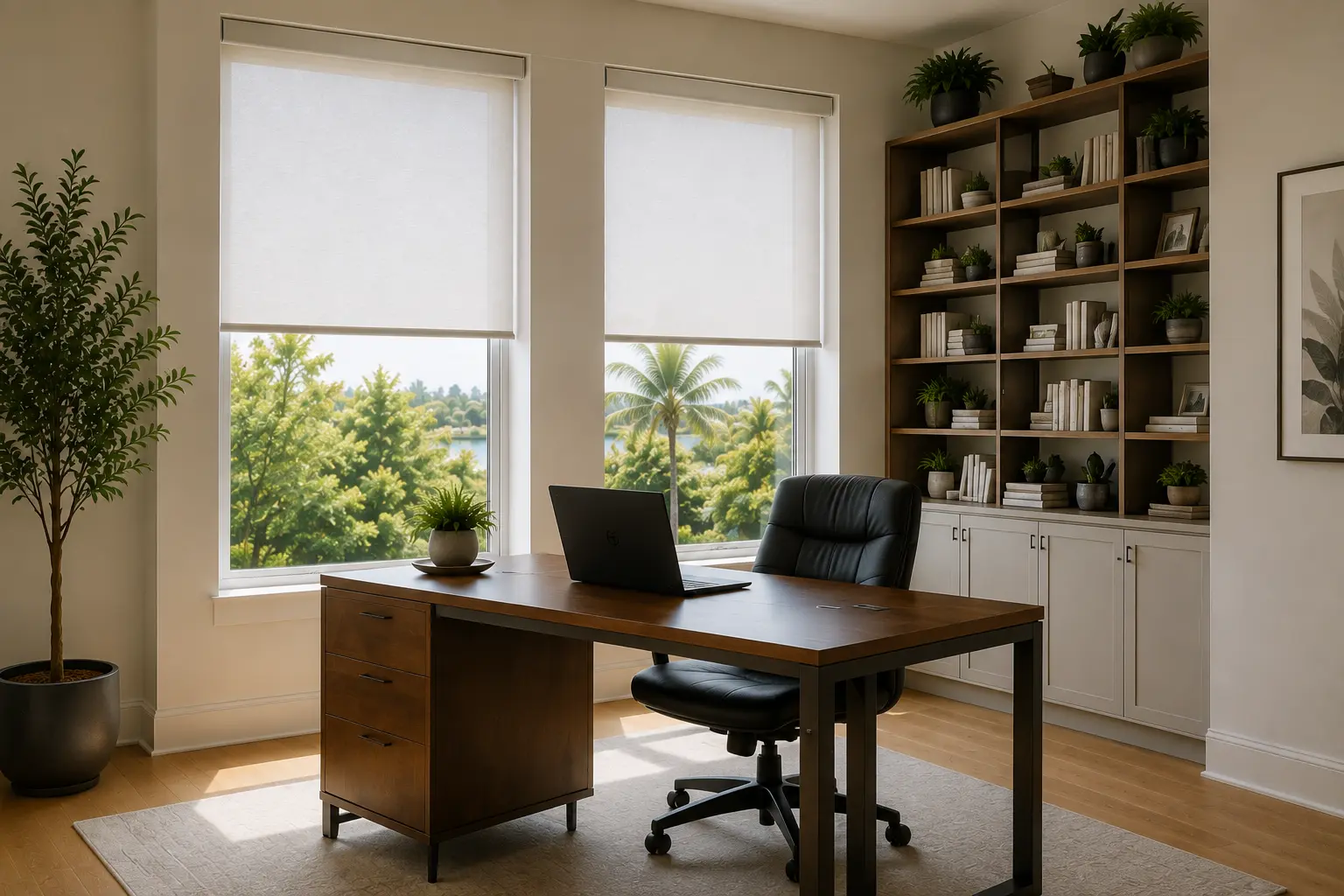
Recent shangri-la shades projects
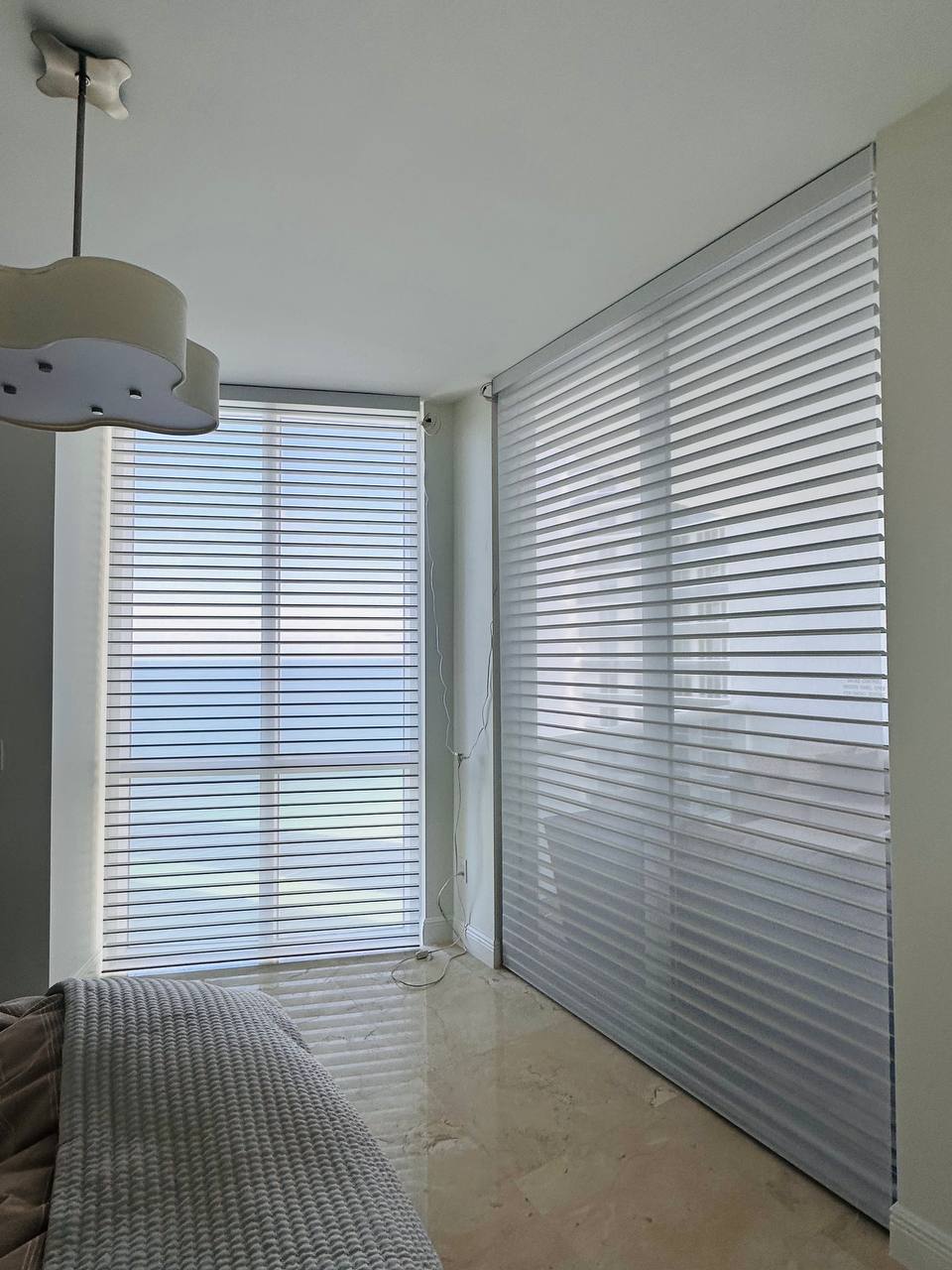
Apartment / Condo · Motorized
Motorized Shangri-La Shades in Miami
Custom motorized Shangri-La shades fitted across large windows and a sliding glass door in a bright Miami apartment or condo.
Shangri-La Shades
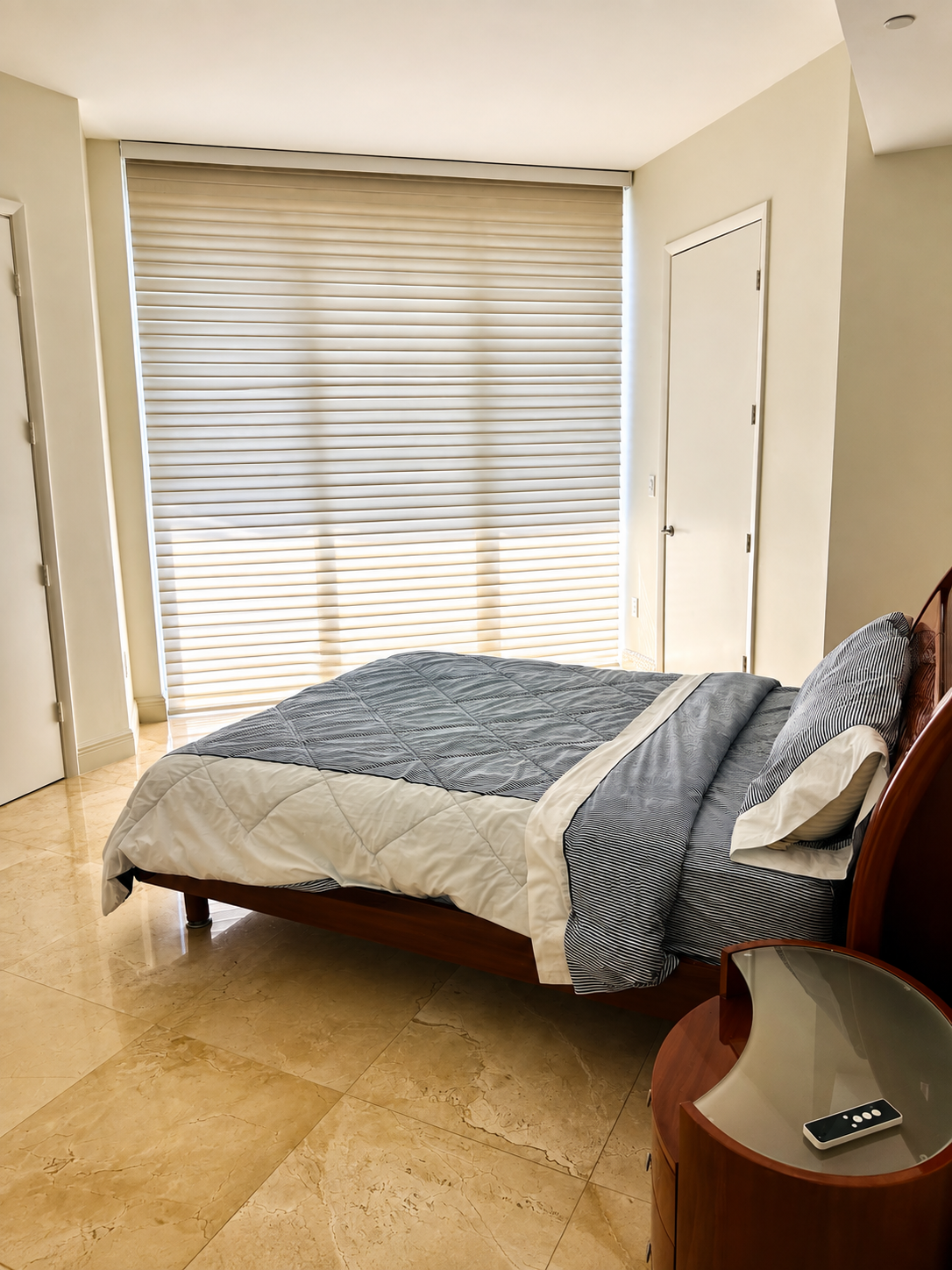
Luxury residence · Motorized (remote)
Motorized Shangri-La Shades – Miami Area Installation
Custom motorized Shangri-La shades installed in a luxury residence in Sunny Isles Beach, in the Miami area, with layered sheer fabric and adjustable vanes for light control, privacy and an open South Florida view.
Shangri-La Shades
Shangri-La Shades installed near you
These are the markets we install shangri-la shades in most often. We cover every city in Miami-Dade, Broward and Palm Beach — see the full service area list.
Other product lines
Alternating sheer and solid bands that switch from soft daylight to privacy in one pull.
Roller ShadesClean, minimal shades in light-filtering, solar screen or blackout fabrics.
Cellular (Honeycomb) ShadesHoneycomb cells that trap air and cut cooling costs in the Florida heat.
Dual ShadesTwo shades on one bracket — solar screen by day, blackout by night.
Outside (Exterior) ShadesPatio and balcony shades that stop heat before it reaches the glass.
Roman ShadesSoft fabric folds that bring warmth and tailored texture to a room.
Drapery & CurtainsCustom drapery panels and curtains that soften a room and layer over any shade.
Free in-home measure across South Florida
Tell us the rooms and we'll bring samples, measure every opening and quote on the spot — no charge, no pressure.