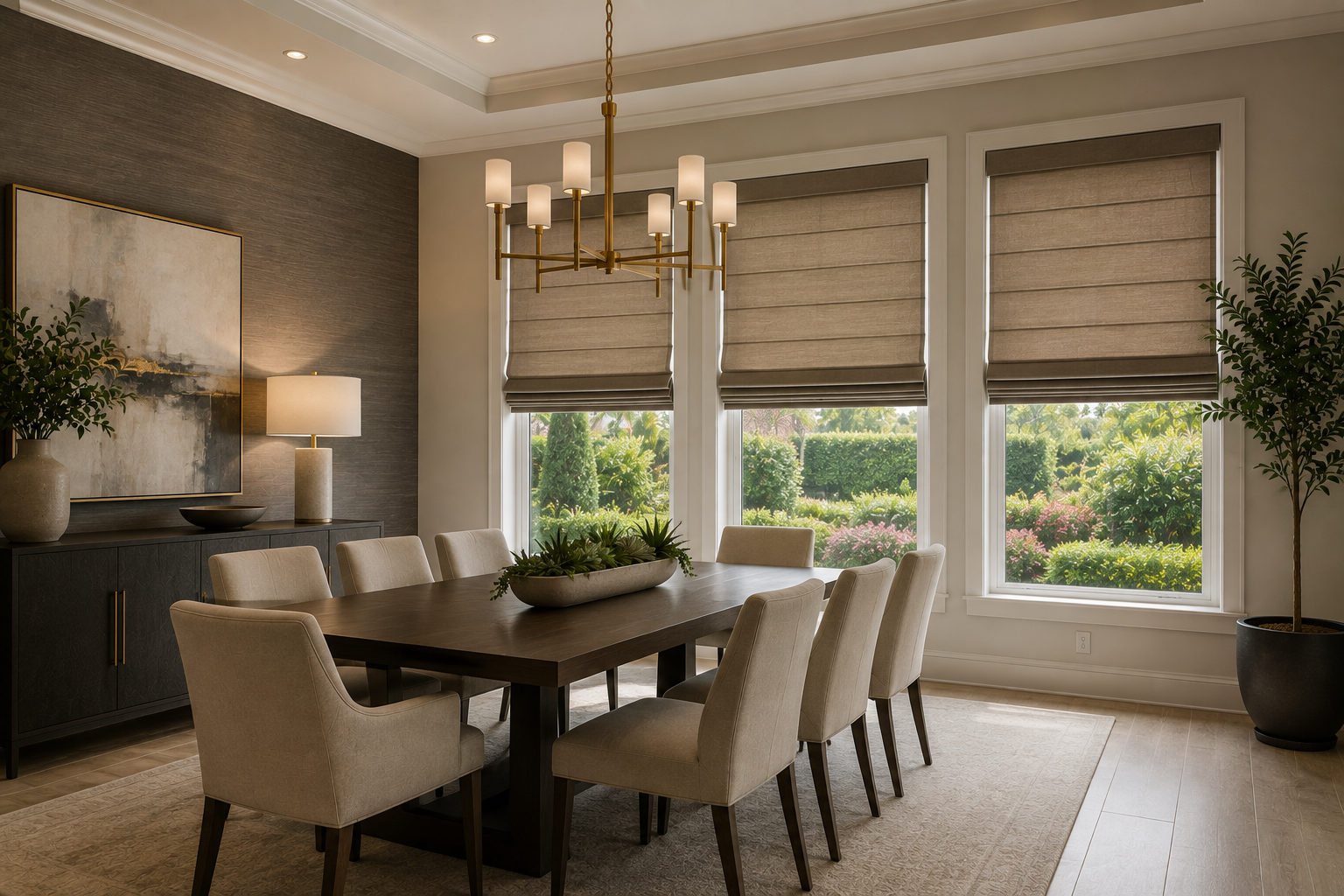
Roman Shades in Miami and South Florida
A roman shade is a fabric panel that draws up into soft horizontal folds. It gives a window the presence of drapery without the width, the stack or the floor space — which is why it is the product interior designers reach for when a room needs texture rather than another flat, technical surface.
Why homeowners choose roman shades
- Flat fold, hobbled and relaxed styles
- Wide range of linens, textures and patterns
- Optional blackout or privacy lining
- Cordless and motorized lifts that are child- and pet-safe
Frequently asked questions
Are roman shades practical in humid rooms?
In kitchens and bathrooms we recommend performance fabrics or a faux-linen blend that resists moisture; pure linen is better kept to living and sleeping areas.
Can roman shades be blackout?
Yes, with a blackout lining. For full darkness we add side channels or pair the shade with a blackout roller behind it.
Styles and how they read in a room
The style determines how the shade looks both raised and lowered, and it changes the character of the window more than the fabric colour does.
- Flat fold — crisp, tailored horizontal folds. The most contemporary option and the one that suits patterned fabrics, because the pattern stays readable when the shade is down.
- Hobbled — permanent soft loops down the whole face, so the shade has depth even when fully lowered. Traditional, generous and well suited to formal rooms.
- Relaxed — a gentle curve at the bottom edge with no rigid rods. Casual, coastal and forgiving on wide, low windows.
Fabric, lining and privacy
Fabric choice is the whole point of a roman shade. Linens and linen-look weaves give texture; cottons and blends hold pattern; heavier decorative fabrics give weight and formality. In South Florida we lean toward performance blends and faux linens, because they hold their shape in high humidity and resist fading far better than untreated natural fibres in strong sun.
Lining does the functional work behind the fabric. An unlined shade glows and shows texture. A privacy lining stops silhouettes and protects the face fabric from sun. A blackout lining is offered where the collection supports it and is what a bedroom needs.
Even with a blackout lining, a roman shade has a soft edge and will let light past the sides on an inside mount. Where full darkness matters we say so and recommend an outside mount with overlap, or a blackout roller mounted behind the roman.
Layering roman shades with other treatments
Roman shades layer better than almost anything else we install. A common specification in a South Florida primary bedroom is a solar or blackout roller at the glass with a roman shade in front of it: the roller does the light control, the roman does the room.
In dining and living rooms the pairing is usually roman shades with drapery panels at the sides — the shade handles privacy, the panels frame the opening and soften the corners.
Operation and safety
We specify cordless lift systems as standard, which removes the hanging cord entirely and is the right default in any home with children or pets.
Motorized operation is available on many roman constructions and is worth considering on tall windows and heavy fabrics, where a manual lift becomes hard work. Fabric weight and shade size determine what is practical, and we confirm the option against the specific fabric selected rather than promising it in advance.
How roman shades compare
Roman shades vs roller shades
A roller is minimal, technical and nearly invisible when raised. A roman is decorative and always present, even raised, because the folds stack at the top of the window. Choose roller for function and view, roman for the way the room looks.
Roman shades vs drapery
Drapery covers the wall beside the window and needs stack space at each side; a roman lives entirely within or just above the opening. In a room with furniture tight to the window, or with a narrow wall return, the roman is often the only workable soft treatment.
Roman shades vs Shangri-La shades
Both are soft and decorative, but a roman is opaque or lined and has no adjustable middle state, while Shangri-La stays sheer and adjusts through its vanes. A room that needs darkness and texture wants a roman; a room that needs adjustable daylight wants Shangri-La.
Rooms and applications
Primary bedrooms
Blackout-lined roman shades, generally on an outside mount, or a roman layered over a blackout roller where the room must be fully dark.
Dining rooms
Hobbled or flat-fold shades in a textured fabric give a formal room the softness that a roller cannot.
Living rooms
Relaxed romans on wide windows, often paired with drapery panels, for a coastal look that still gives evening privacy.
Kitchens and bathrooms
Possible with performance or faux-linen fabrics that tolerate moisture; we steer away from pure linen and silk in these rooms.
How to measure for roman shades
A roman shade is fabricated as a fixed panel with a fixed fold layout, so the measurement decides not only the fit but how the folds will fall.
- Measure width at top, middle and bottom and height at left, center and right; a roman shows an out-of-square opening more clearly than a roller does because the fold lines are horizontal references.
- Confirm the headrail depth available — the mounting board and lift mechanism need more depth than a roller tube.
- Decide the stack: even fully raised, the folds occupy height at the top of the window. Where the glass must stay clear, mount above the opening.
- Note the trim and sill; on an inside mount the fabric will sit inside the reveal with visible side gaps, which some fabrics show more than others.
- For an outside mount, plan the mounting board width and the overlap on all four sides so the shade looks intentional.
- Discuss the fold layout at the measure — fold size and count are set during fabrication and cannot be changed on site.
DIY measurements are useful for planning and preliminary estimates. Final measurements for custom-made window treatments should be verified professionally before production — see our measuring guide or book a free professional measurement.
Professional installation
- 1.The mounting board position is set and levelled first; on a roman shade the top line governs how every fold reads.
- 2.The shade is fixed and the lift system is checked through full travel so the folds break in the intended places.
- 3.Folds are dressed by hand after hanging so the panel settles evenly across the width.
- 4.Where the shade layers over an existing roller or under drapery, clearances are checked so nothing catches.
- 5.Motorized romans have their limits set and their operation tested at the intended fabric weight.
Care and cleaning
- Dust regularly with a soft brush attachment; fabric shades collect more dust than technical fabrics.
- Spot-clean carefully and test any cleaner on a hidden area first — most decorative fabrics are dry-clean only.
- Leave the shade fully lowered for a period after installation so the folds settle, and re-dress the folds after any cleaning.
Helpful guides
Often compared with
Recent roman shades projects
We publish project pages only from installations we actually completed, with the real city, fabric and control type. Photos from recent Roman Shades projects jobs are added as each record is finalised.
Roman Shades installed near you
These are the markets we install roman shades in most often. We cover every city in Miami-Dade, Broward and Palm Beach — see the full service area list.
Other product lines
Alternating sheer and solid bands that switch from soft daylight to privacy in one pull.
Roller ShadesClean, minimal shades in light-filtering, solar screen or blackout fabrics.
Shangri-La ShadesSoft fabric vanes suspended between sheer layers for elegant daylight, privacy and adjustable light control.
Cellular (Honeycomb) ShadesHoneycomb cells that trap air and cut cooling costs in the Florida heat.
Dual ShadesTwo shades on one bracket — solar screen by day, blackout by night.
Outside (Exterior) ShadesPatio and balcony shades that stop heat before it reaches the glass.
Drapery & CurtainsCustom drapery panels and curtains that soften a room and layer over any shade.
Free in-home measure across South Florida
Tell us the rooms and we'll bring samples, measure every opening and quote on the spot — no charge, no pressure.