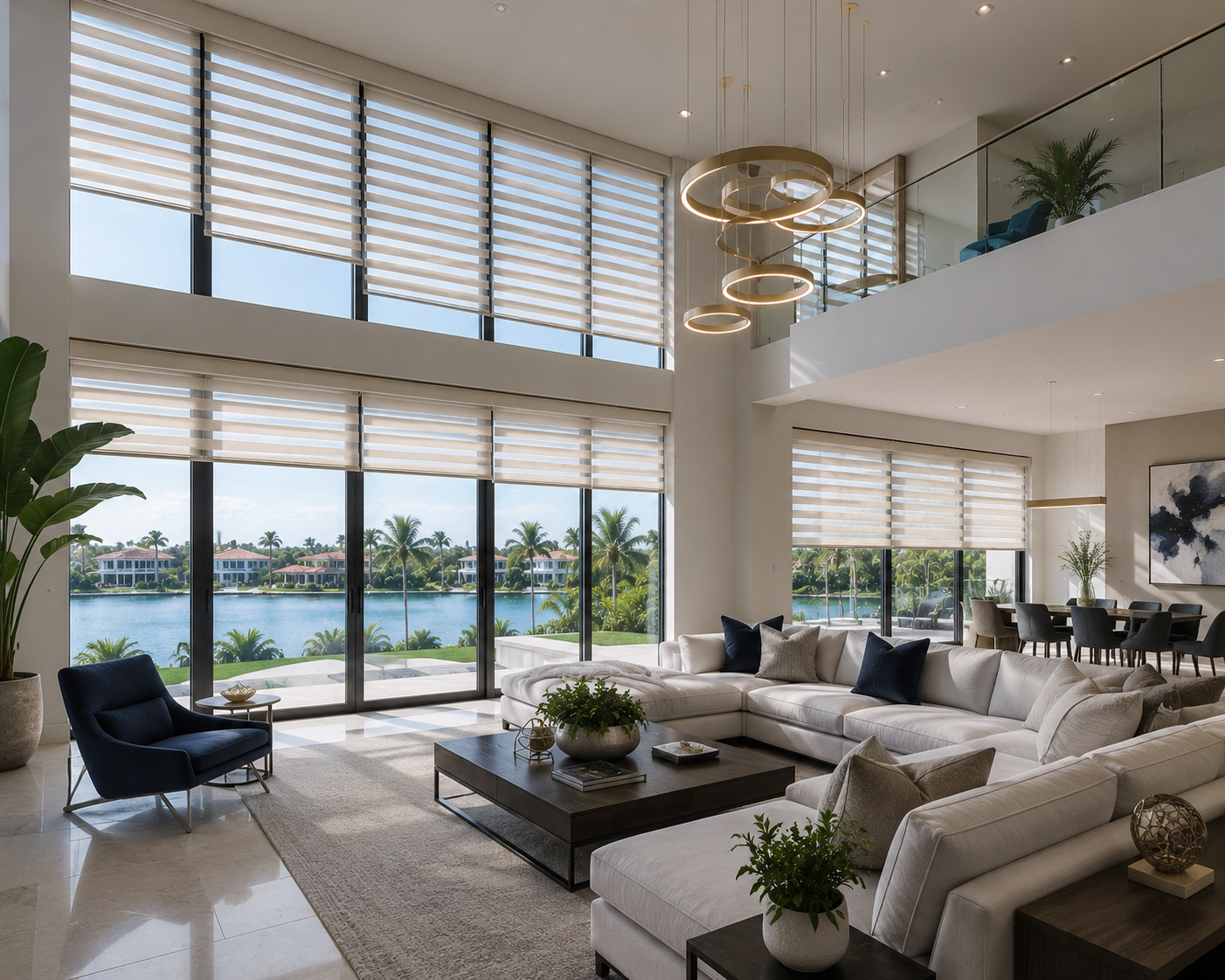
Dual Shades in Miami and South Florida
A dual shade system puts two completely separate roller shades on one bracket set: typically a solar screen or light-filtering layer for the day, and a blackout or privacy layer for the night. Each layer is operated independently, so the window has two genuinely different modes rather than a compromise between them.
Why homeowners choose dual shades
- Day/night flexibility without changing hardware
- Keeps the view during the day and full darkness at night
- Single fascia keeps the installation looking like one clean unit
- Ideal for motorization with separate day and night scenes
Frequently asked questions
Can each layer be motorized separately?
Yes. Each roller gets its own motor, so a single remote or app button can set a daytime scene, an evening scene and full blackout.
How much space does a dual shade need?
Plan for roughly 5-6 inches of mounting depth for an inside mount; otherwise we use an outside mount with a matching fascia.
A dual shade is not a zebra shade
This distinction causes more confusion than any other in our catalogue, so it is worth being precise. A zebra shade is one fabric with alternating sheer and solid bands on a single tube. A dual shade is two separate fabrics on two separate tubes, sharing one headrail or bracket assembly.
The consequence is practical. A zebra shade cannot darken a room, because its sheer bands are always part of the fabric. A dual shade can, because the second layer is a genuine blackout fabric with nothing translucent in it. In exchange, the dual system needs more mounting depth and costs more to install.
For the same reason, we never show ordinary zebra photography as evidence of a dual shade installation. They are different systems and they look different at the window.
The two layers and how they are used
The front layer is normally a solar screen or a light-filtering fabric. Through the day it stays down: glare and heat are cut and, with a screen fabric, the outward view remains.
The back layer is a blackout or privacy fabric that stays rolled up until it is needed. At night, or for sleep, film watching and video calls, it comes down and the window closes completely.
Because both layers live in one assembly, you get a single clean unit at the top of the window instead of two shades installed on top of each other at different depths.
- Day mode — solar or light-filtering layer down, blackout layer up
- Evening mode — blackout layer down for privacy and darkness
- Both up — the window is fully clear
- Shared fascia or cassette so the installation reads as one unit
Mounting depth is the deciding factor
Two tubes in one bracket need meaningfully more depth than a single roller. On many South Florida condos the window pocket is shallow, and the honest answer is that an inside-mount dual system will not fit.
When that happens there are two routes: an outside mount with a fascia that covers the assembly and sits proud of the opening, or two separate shades installed at different depths. We work out which is achievable at the measure, before anything is ordered.
Controls and motorization
Manual dual shades use two independent chains or cordless lifts, one per layer. This is simple and reliable, but it does mean two controls at the window.
Motorized dual shades give each layer its own motor, and this is where the system really earns its place: one button sets a daytime scene, another closes the blackout layer for the evening, and a schedule can run the transition automatically. On a wall of glass, grouped motors move every layer in unison.
How dual shades compare
Dual shades vs zebra shades
Zebra is one fabric with two states and a slim profile; dual is two fabrics with two independent shades and a genuine blackout capability. If the room truly needs to go dark, dual. If it needs view-versus-privacy in a shallow pocket, zebra.
Dual shades vs a single roller shade
A single roller does one job well. A dual system is what you specify when one window genuinely has two conflicting jobs — daytime view and nighttime darkness — and when there is enough depth to carry both layers.
Dual shades vs roller plus drapery
Layering a blackout drapery over a solar roller achieves a similar day/night result with a softer, more decorative look, and needs less mounting depth at the head. Dual is the cleaner, more contemporary and more easily motorized option; drapery is the warmer one.
Rooms and applications
Primary bedrooms
The classic case: screen fabric during the day so the room stays usable, blackout at night so it stays dark past sunrise.
Rooms that double as offices
Screen layer for daytime work, blackout layer for calls, presentations and evening privacy on a ground floor.
Waterfront condos
Keeping the water view through the day and closing the glass completely at night is exactly what a dual system is for.
Media rooms
Blackout on demand without giving up daylight the rest of the time.
How to measure for dual shades
Everything about measuring a dual shade starts with depth. Two rollers, two fabrics and a shared fascia need room, and confirming that space is the first thing we do at the window.
- Measure the mounting depth precisely from the face of the glass to the front edge of the opening — this determines whether an inside mount is possible at all.
- Measure width at top, middle and bottom and height at left, center and right, as with any roller product.
- Account for both tubes: a wider or taller shade needs a larger tube diameter on each layer, which increases the depth required.
- Decide where the blackout layer sits — closest to the glass — and confirm nothing on the frame will foul it.
- For an outside mount, plan the fascia size and the overlap on each side so the assembly looks intentional rather than oversized.
- Confirm the control side and whether the two layers should be motorized independently or grouped.
DIY measurements are useful for planning and preliminary estimates. Final measurements for custom-made window treatments should be verified professionally before production — see our measuring guide or book a free professional measurement.
Professional installation
- 1.Depth, fabric order and layer positions are confirmed on site against the measured spec.
- 2.The shared bracket set is levelled and secured, then each tube is seated and checked for free travel.
- 3.Both layers are run to full drop and checked so neither fabric rubs the other or the frame.
- 4.The fascia or cassette is fitted last so the assembly reads as a single unit.
- 5.Motorized layers are given separate limits, then grouped, named and tested — day scene and night scene both demonstrated before we leave.
Care and cleaning
- Dust both layers separately; the screen layer releases dust easily, the blackout layer should be wiped with a barely damp cloth.
- Never scrub a coated blackout backing — it is a laminate and can mark permanently.
- Keep both fabrics tracking centrally; report any creep early so brackets can be adjusted rather than the fabric forced.
Helpful guides
Often compared with
Recent dual shades projects
We publish project pages only from installations we actually completed, with the real city, fabric and control type. Photos from recent Dual Shades projects jobs are added as each record is finalised.
Dual Shades installed near you
These are the markets we install dual shades in most often. We cover every city in Miami-Dade, Broward and Palm Beach — see the full service area list.
Other product lines
Alternating sheer and solid bands that switch from soft daylight to privacy in one pull.
Roller ShadesClean, minimal shades in light-filtering, solar screen or blackout fabrics.
Shangri-La ShadesSoft fabric vanes suspended between sheer layers for elegant daylight, privacy and adjustable light control.
Cellular (Honeycomb) ShadesHoneycomb cells that trap air and cut cooling costs in the Florida heat.
Outside (Exterior) ShadesPatio and balcony shades that stop heat before it reaches the glass.
Roman ShadesSoft fabric folds that bring warmth and tailored texture to a room.
Drapery & CurtainsCustom drapery panels and curtains that soften a room and layer over any shade.
Free in-home measure across South Florida
Tell us the rooms and we'll bring samples, measure every opening and quote on the spot — no charge, no pressure.