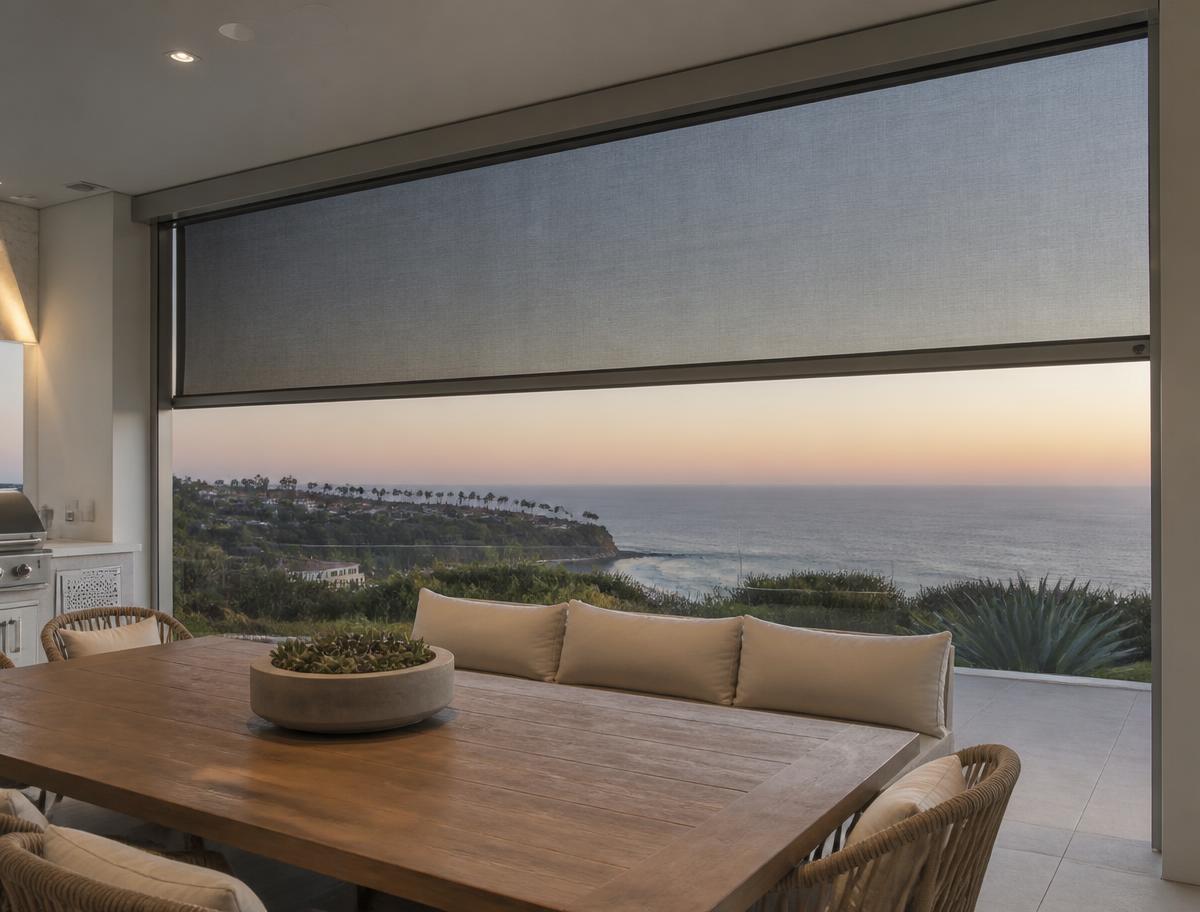
Outside & Exterior Shades in Miami and South Florida
Exterior shades stop solar heat before it reaches the building. Instead of managing sunlight after it has passed through the glass and into the room, an outside shade intercepts it at the outer face of the opening — which is why a shaded lanai or balcony stays usable on an afternoon when an unshaded one does not.
Why homeowners choose outside (exterior) shades
- Blocks solar heat outside the glass, before it enters the home
- Makes patios, lanais and balconies comfortable year-round
- Cuts wind, glare and insects on screened openings
- Manual crank or motorized with wind sensors
Frequently asked questions
Will exterior shades survive a Florida storm?
They are sun and rain rated, not hurricane rated. We install them so they can be retracted quickly, and motorized systems can include a wind sensor that raises them automatically.
Can I still see out through them?
Yes. Mesh fabrics keep the outward view while cutting glare and heat; lower openness percentages mean more shade and slightly less visibility.
Stopping heat before the glass
Once sunlight passes through glass, most of its energy is already inside the building. An interior shade can control glare and can slow re-radiation, but it is working after the fact. An exterior shade works before it — the fabric absorbs and reflects energy outside, and the air behind it carries much of the rest away.
That is the reason exterior shades are the strongest solar-control option available for outdoor living areas in South Florida, and why they are commonly specified on west-facing patios, pool decks and upper-floor balconies.
Fabrics, mesh and hardware
Exterior fabrics are typically PVC-coated polyester meshes designed for continuous UV exposure, rain and salt air. They are woven with an openness that keeps the outward view while cutting glare — you look through the shade, not at it.
Hardware is selected for the same environment: powder-coated aluminium housings and corrosion-resistant fixings rather than interior-grade components. On coastal properties this matters far more than the fabric choice, because it is the hardware that fails first when the wrong parts are used near salt spray.
- Open-mesh solar fabrics that keep the view while cutting glare and heat
- Solid weather-block fabrics where wind and rain protection is the priority
- Cable-guided, side-track and zip-track systems for wider spans
- Corrosion-resistant hardware and housings for coastal exposure
Mounting and operation
Exterior shades are mounted to the structure above the opening — a soffit, a beam, a lanai frame or an outside wall — and can drop free, run in side cables, or run in tracks. Guided systems hold the fabric steadier in wind and are what we recommend on any exposed opening.
Operation is by hand crank or by motor. Motorized exterior shades are the norm on wide or high openings and can be set to retract automatically via a wind sensor, which is the single most useful accessory on a Florida balcony.
Weather, wind and honest limits
We want to be direct about this: exterior shades are sun, rain and everyday weather products. They are not storm protection and they are not a substitute for shutters or impact glazing.
We do not quote wind ratings, engineering approvals or certifications for these systems. What we do is install them so they retract quickly and easily, recommend a wind sensor on motorized units, and tell you plainly that the shade should be up before serious weather arrives.
How outside (exterior) shades compare
Exterior shades vs interior solar shades
An interior solar shade controls glare and protects furnishings; an exterior shade reduces the heat load before it enters. On a patio or a lanai — where there is no glass at all — only an exterior shade is possible. On a glazed room, the two can be combined.
Exterior shades vs awnings
An awning shades from above and leaves the sides open. An exterior shade closes the opening vertically, which controls low afternoon sun far better and adds privacy to a balcony that overlooks a neighbour.
Exterior shades vs screens
A conventional screen keeps insects out and is permanent. A retractable exterior shade controls sun and wind on demand and rolls away when you want the space fully open — many properties end up with both.
Rooms and applications
Patios and lanais
The most common installation. Vertical shades on the exposed sides turn an unusable afternoon patio into shaded outdoor living space.
Balconies in high-rises
Sun control plus privacy from neighbouring towers, with a wind sensor so the shade retracts on its own when the breeze picks up.
Pool decks
Shade over seating areas and glare control on the water, with fabrics chosen for constant UV and chlorine-laden air.
Pergolas and outdoor kitchens
Drop screens on the windward and sun-facing sides keep the space comfortable through the middle of the day.
How to measure for outside (exterior) shades
Exterior openings are rarely as regular as interior windows, so measuring is as much about the structure and the mounting surface as it is about the dimensions.
- Identify the mounting surface first — soffit, beam face, wall or column — and confirm it is sound enough to carry a loaded housing.
- Measure the full opening width and the drop from the mounting point to the finished floor or the intended stopping height.
- Check that the housing will clear lights, fans, sprinklers, gutters and hurricane-shutter tracks.
- Note the fall of the deck or patio; a sloping floor changes where the bottom bar lands across the width.
- For guided systems, confirm where cables or tracks can be anchored at the bottom and that those anchors are in a safe walking line.
- Confirm power access for motorized units, or plan for a rechargeable or solar-charged motor where no supply exists.
DIY measurements are useful for planning and preliminary estimates. Final measurements for custom-made window treatments should be verified professionally before production — see our measuring guide or book a free professional measurement.
Professional installation
- 1.Mounting surfaces and fixings are checked before installation, and anchors are chosen for the actual substrate.
- 2.The housing is set level and secured, and clearance is confirmed against lights, fans and existing shutter hardware.
- 3.Guides, cables or tracks are aligned and tensioned so the fabric runs straight through its full drop.
- 4.Motorized units are wired or charged, limits are set, and any wind sensor is positioned and tested.
- 5.We run the shade fully up and down with you, and explain when it should be retracted.
Care and cleaning
- Rinse the fabric with fresh water periodically — salt and dust are what age an exterior mesh fastest.
- Retract the shade before storms and high wind, and never leave a wet shade rolled for long periods.
- Keep tracks and cables clear of debris and check fixings once a year on coastal properties.
Helpful guides
Often compared with
Recent outside (exterior) shades projects
We publish project pages only from installations we actually completed, with the real city, fabric and control type. Photos from recent Outside (Exterior) Shades projects jobs are added as each record is finalised.
Outside (Exterior) Shades installed near you
These are the markets we install outside (exterior) shades in most often. We cover every city in Miami-Dade, Broward and Palm Beach — see the full service area list.
- Outside (Exterior) Shades in Miami
- Outside (Exterior) Shades in Miami Beach
- Outside (Exterior) Shades in Fort Lauderdale
- Outside (Exterior) Shades in Boca Raton
- Outside (Exterior) Shades in Aventura
- Outside (Exterior) Shades in Hollywood
- Outside (Exterior) Shades in Coral Gables
- Outside (Exterior) Shades in Coral Springs
Other product lines
Alternating sheer and solid bands that switch from soft daylight to privacy in one pull.
Roller ShadesClean, minimal shades in light-filtering, solar screen or blackout fabrics.
Shangri-La ShadesSoft fabric vanes suspended between sheer layers for elegant daylight, privacy and adjustable light control.
Cellular (Honeycomb) ShadesHoneycomb cells that trap air and cut cooling costs in the Florida heat.
Dual ShadesTwo shades on one bracket — solar screen by day, blackout by night.
Roman ShadesSoft fabric folds that bring warmth and tailored texture to a room.
Drapery & CurtainsCustom drapery panels and curtains that soften a room and layer over any shade.
Free in-home measure across South Florida
Tell us the rooms and we'll bring samples, measure every opening and quote on the spot — no charge, no pressure.