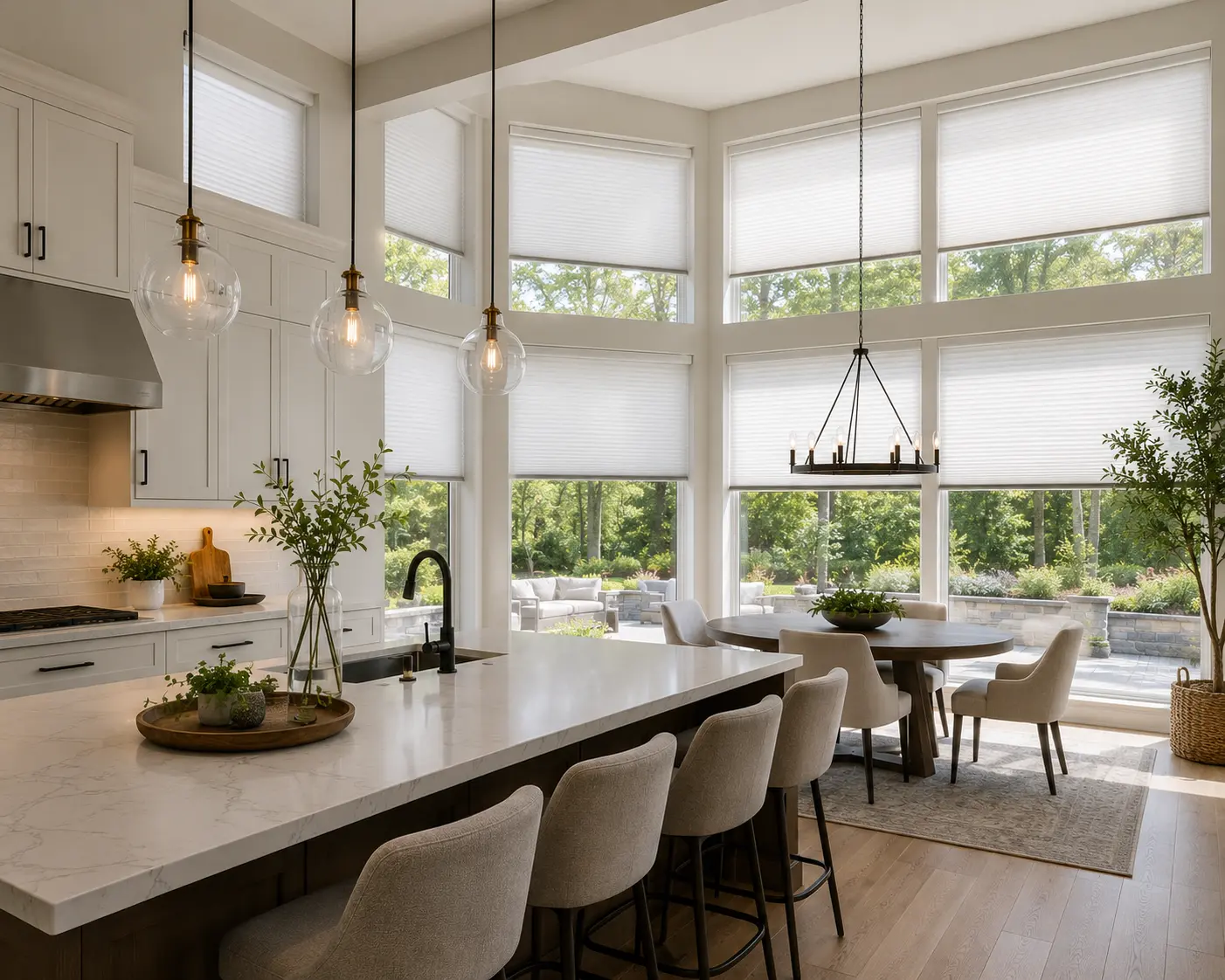
Cellular & Honeycomb Shades in Miami and South Florida
Cellular shades — usually called honeycomb shades — are made from pleated fabric folded into hexagonal cells. Those cells hold a pocket of still air between the room and the glass. In a climate where the air conditioning runs for most of the year, adding a layer of trapped air at the window is one of the simplest changes you can make at the opening itself.
Why homeowners choose cellular (honeycomb) shades
- Highest insulation value of any soft window treatment
- Single, double and blackout cell options
- Top-down/bottom-up operation for daylight with privacy
- Compact stack that nearly vanishes at the top of the window
Frequently asked questions
Do cellular shades really lower cooling costs?
They add a measurable insulating layer at the glass, which is where most heat enters a Florida home. Double-cell and blackout cell constructions perform best on sun-exposed windows.
What is top-down/bottom-up?
The shade opens from the top as well as the bottom, so you can let daylight in over the top while the lower half of the window stays covered for privacy.
How honeycomb construction works
The fabric is bonded into a repeating row of cells so that, when the shade is lowered, each cell forms a closed air pocket running the width of the window. Still air is a poor conductor of heat, so the pocket slows heat transfer between the glass and the room. That is the whole concept — no coating, no mechanism, just geometry.
Cells come in different depths, and shades are offered in single-cell and double-cell constructions. A deeper or doubled cell holds more air and therefore does more insulating work, at the cost of a slightly bulkier stack when the shade is raised.
We describe the effect in terms of how the room feels and how the glass behaves, not in percentages. Published energy figures depend on the specific fabric, glazing, orientation and installation, and we do not quote numbers we cannot verify for your window.
Light filtering, room darkening and blackout cells
Standard honeycomb fabric is translucent: it glows softly, gives complete daytime privacy and never shows a silhouette the way a thin sheer can. This is the most common specification for living areas.
Blackout cellular shades add an opaque liner inside the cell. The fabric itself stops the light; as with any shade, light around the perimeter is controlled by the mount, so bedrooms usually get an outside mount with overlap or side channels where the trim allows.
- Light filtering — soft, even daylight with full daytime privacy
- Room darkening and blackout cells — for bedrooms, nurseries and media rooms
- Top-down/bottom-up — the shade opens from the top as well as the bottom, so daylight comes in high while the lower window stays private
- Cordless, continuous-chain and motorized lifts
Why cellular shades make sense in Florida
Most of the heat entering a South Florida home arrives through glass. Once it is inside, the air conditioning has to remove it. A cellular shade works at the point of entry, which is why we recommend them on west-facing bedrooms, over-glazed rooms that never feel cool, and any room where the AC visibly struggles in the afternoon.
They also perform a second, quieter job: the cell structure absorbs some sound, which is noticeable in homes near a main road or a flight path.
The trade-off is honest — a cellular shade has no view-through at all. Where the view is the reason the window exists, a solar screen roller is the better product, and the two are often used in the same house on different facades.
How cellular (honeycomb) shades compare
Cellular vs roller shades
Rollers offer solar screen fabrics with genuine view-through; cellular shades do not. Cellular offers insulating air pockets; rollers do not. Choose by what the room needs: view and glare control point to a roller, thermal comfort and privacy point to cellular.
Cellular vs zebra shades
Zebra is about switching between view and privacy. Cellular is about comfort and darkness. A zebra shade in a hot west bedroom will control glare but will not do much for the temperature; a cellular shade in a view-focused living room will keep the room comfortable but hide the water.
Cellular vs blackout roller
Both can darken a bedroom. A blackout roller is flatter and slimmer, a blackout cellular adds insulation and a softer surface. Where the bedroom is also the hottest room in the house, the cellular usually wins.
Rooms and applications
Bedrooms and nurseries
Blackout cells plus an outside mount with overlap gives darkness and thermal comfort in one product, which is why this is the pairing we install most.
Living rooms
Light-filtering cells give a soft, even wash of daylight and full daytime privacy on street-facing glass.
Kitchens
Top-down/bottom-up is particularly useful over a sink or counter: light stays high, the lower window stays private.
Home offices and guest rooms
Even, diffused light with no view-through means no reflections on a screen and no distraction from the street.
How to measure for cellular (honeycomb) shades
Cellular shades stack when raised, and the stack has real height. Measuring is about the opening dimensions and about where that stack will sit relative to the glass you want to keep clear.
- Measure width at top, middle and bottom and height at left, center and right — cellular shades are fabricated to tight tolerances and a squareness error shows quickly.
- Check the frame depth: an inside-mount headrail needs enough depth to sit within the opening, and blackout units with side channels need more.
- Allow for the stack. On a short window, a raised cellular shade can cover a noticeable portion of the glass; where that matters, an outside mount above the opening keeps the glass clear.
- For top-down/bottom-up, plan for both a top rail and a bottom rail, which requires more headrail space than a standard lift.
- For blackout bedrooms, confirm whether the trim allows side channels or whether an outside mount with overlap is the better route.
- Note obstructions — handles and cranks interfere with the headrail and with the shade's travel.
DIY measurements are useful for planning and preliminary estimates. Final measurements for custom-made window treatments should be verified professionally before production — see our measuring guide or book a free professional measurement.
Professional installation
- 1.Sizes, cell type, opacity and lift are checked against the order before installation starts.
- 2.Headrail brackets are levelled carefully, since a pleated shade shows an out-of-level top rail immediately.
- 3.Each shade is raised and lowered through full travel and the pleats checked for even stacking.
- 4.Top-down/bottom-up units are adjusted so both rails move freely and sit parallel.
- 5.Motorized units have limits set and controls paired and tested before we leave.
Care and cleaning
- Vacuum on low suction with a brush attachment, running along the pleats rather than into them.
- Blow dust out of the cells with low-pressure air or a hair dryer on a cool setting if it settles inside.
- Avoid wetting a cellular shade; if a spot must be cleaned, use a barely damp cloth and dry it fully extended.
Helpful guides
Often compared with
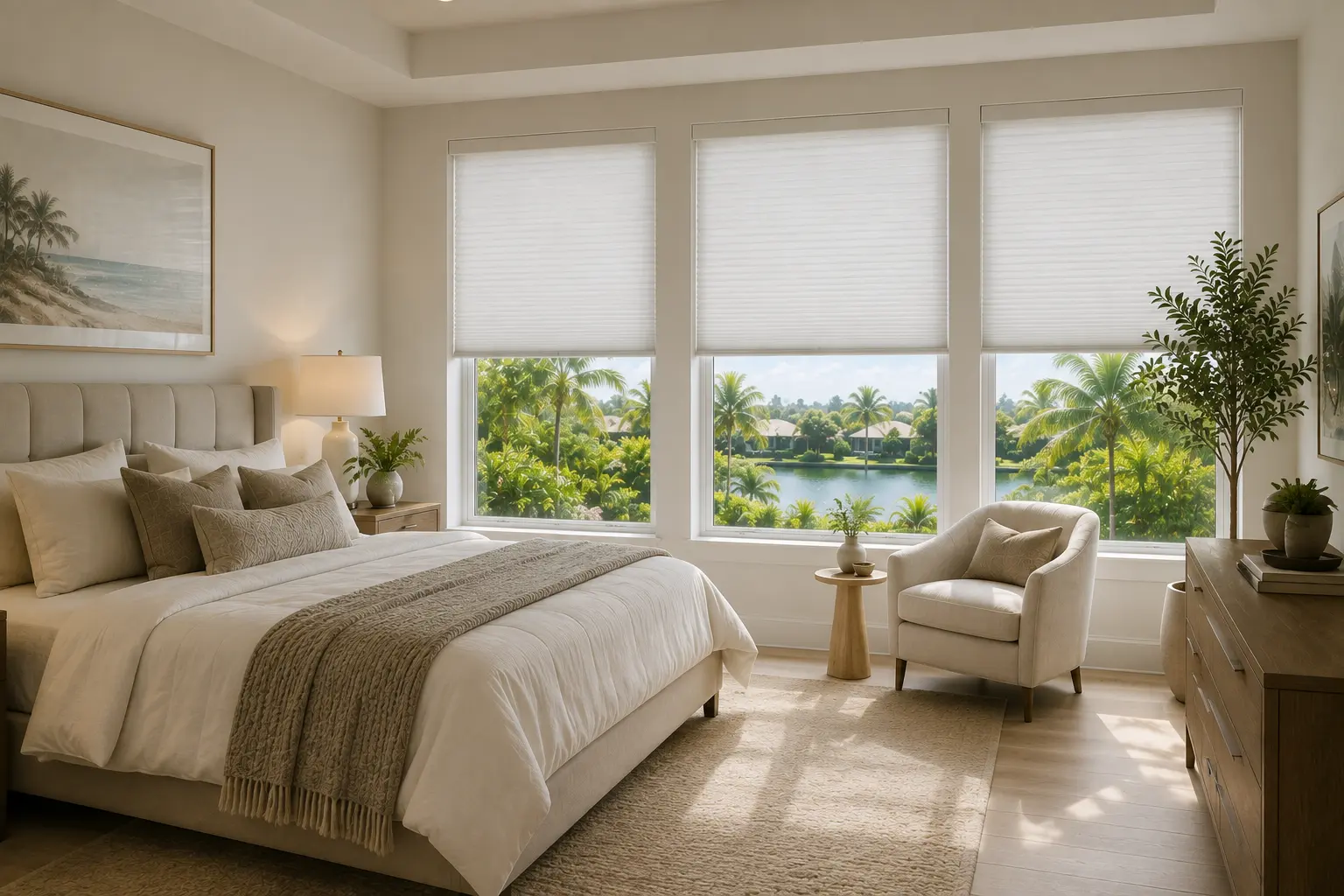
Recent cellular (honeycomb) shades projects
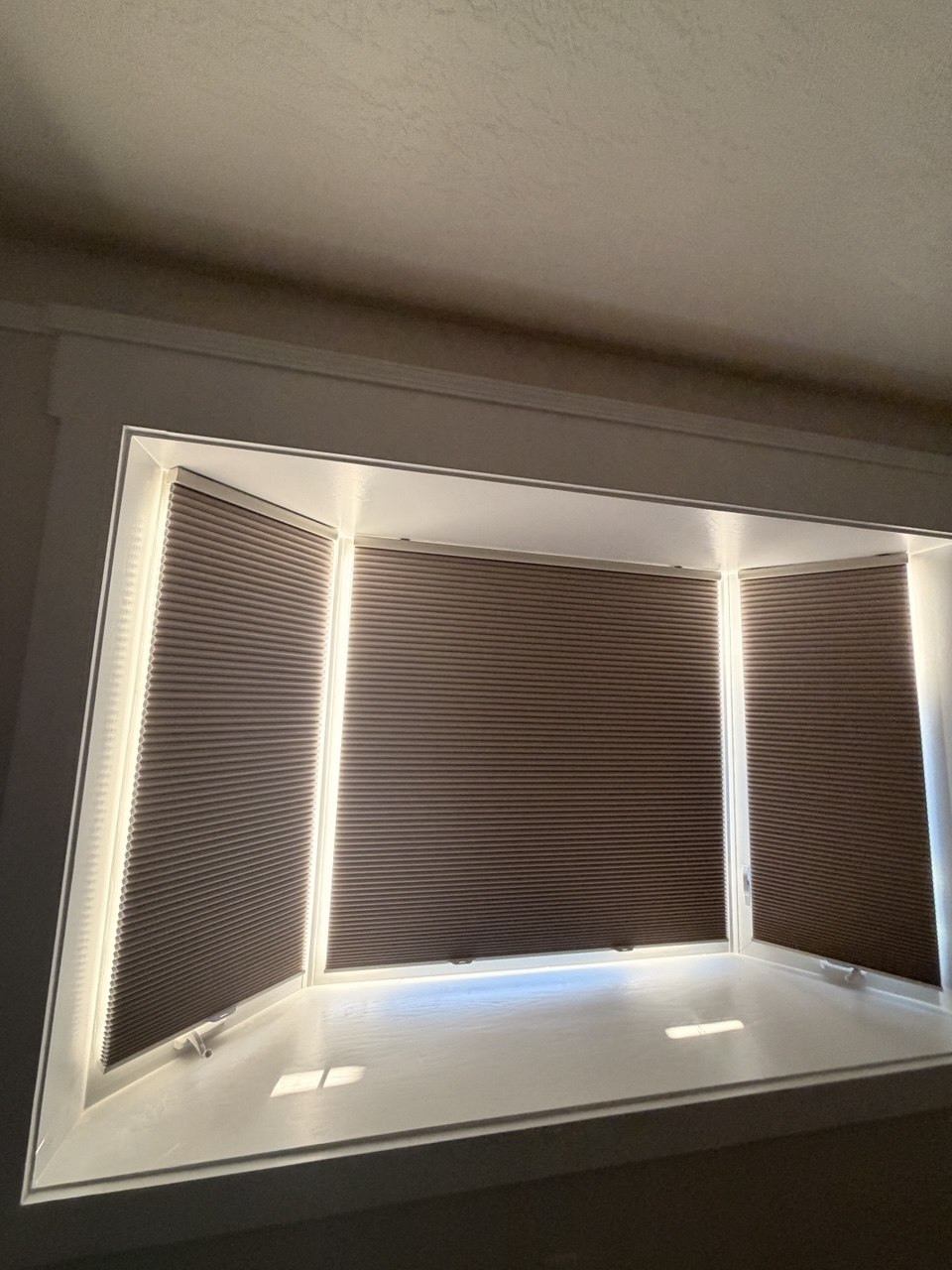
Cellular (Honeycomb) Shades installed near you
These are the markets we install cellular (honeycomb) shades in most often. We cover every city in Miami-Dade, Broward and Palm Beach — see the full service area list.
- Cellular (Honeycomb) Shades in Miami
- Cellular (Honeycomb) Shades in Miami Beach
- Cellular (Honeycomb) Shades in Fort Lauderdale
- Cellular (Honeycomb) Shades in Boca Raton
- Cellular (Honeycomb) Shades in Aventura
- Cellular (Honeycomb) Shades in Hollywood
- Cellular (Honeycomb) Shades in Coral Gables
- Cellular (Honeycomb) Shades in Coral Springs
Other product lines
Alternating sheer and solid bands that switch from soft daylight to privacy in one pull.
Roller ShadesClean, minimal shades in light-filtering, solar screen or blackout fabrics.
Shangri-La ShadesSoft fabric vanes suspended between sheer layers for elegant daylight, privacy and adjustable light control.
Dual ShadesTwo shades on one bracket — solar screen by day, blackout by night.
Outside (Exterior) ShadesPatio and balcony shades that stop heat before it reaches the glass.
Roman ShadesSoft fabric folds that bring warmth and tailored texture to a room.
Drapery & CurtainsCustom drapery panels and curtains that soften a room and layer over any shade.
Free in-home measure across South Florida
Tell us the rooms and we'll bring samples, measure every opening and quote on the spot — no charge, no pressure.