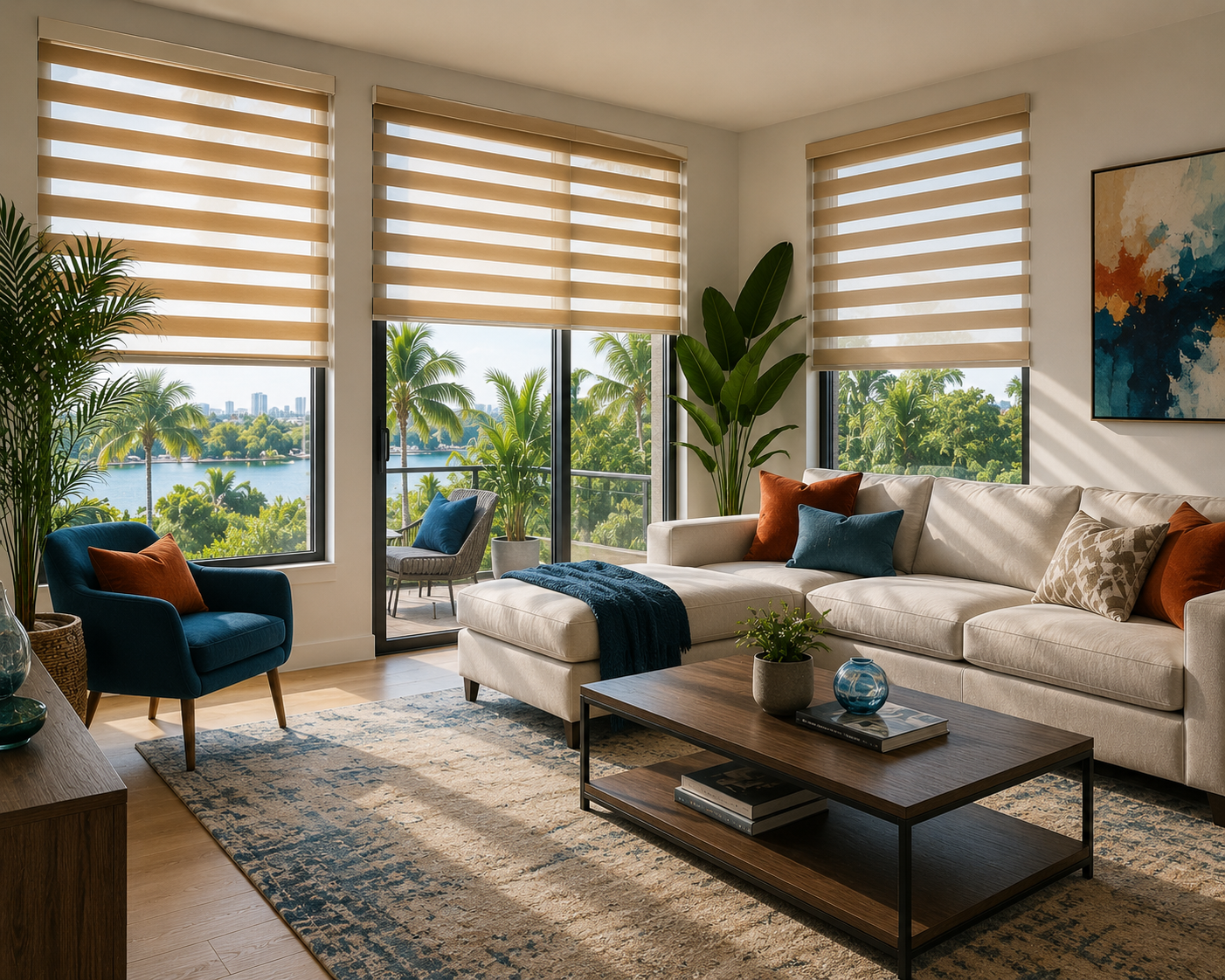
Zebra Blinds & Zebra Shades in Miami and South Florida
Zebra blinds — also sold as zebra shades, transitional shades or day-night banded shades — roll like a roller shade but use alternating sheer and solid horizontal bands. Line the solid bands up with the sheers and you get a soft, filtered view. Offset them and the solid bands close the gaps for privacy. One fabric, two very different rooms, no second shade required.
Why homeowners choose zebra blinds
- Two shades in one: light filtering and privacy on the same roll
- Cuts glare on TVs and monitors while keeping the view
- Slim cassette valance fits shallow window pockets common in South Florida condos
- Moisture-tolerant polyester fabrics suited to coastal humidity
Frequently asked questions
Do zebra blinds block the sun completely?
Closed solid bands block most direct sunlight and provide full nighttime privacy. For total blackout in a bedroom, we pair them with a blackout roller shade or a side-channel blackout option.
Are zebra blinds good for humid Florida homes?
Yes. We specify woven polyester fabrics and rust-resistant hardware suited to coastal humidity and salt exposure, rather than natural wood or untreated fabrics.
What zebra shades are
A zebra shade is a single continuous loop of fabric woven in stripes: a translucent sheer band, then an opaque solid band, repeating down the whole drop. The loop passes over a roller tube inside a cassette or open headrail, so the front and back layers of the loop move against each other as the shade travels.
Because the two layers slide past one another, the shade has a range of positions rather than just open and closed. That is the practical difference between a zebra shade and an ordinary roller shade, and it is why zebra shades became the default choice for South Florida living rooms where the same window has to handle a bright morning, a harsh afternoon and an exposed evening.
How zebra blinds work — daylight and privacy positions
Think of the shade as having three working states rather than two.
- Sheer aligned with sheer — the most open position. Daylight passes through, the outward view stays readable, and direct glare is knocked down without the room going dark.
- Partly offset — a halfway position that keeps some view through the sheer bands while cutting more of the light. This is where most people leave a west-facing window in the afternoon.
- Solid over sheer — the closed position. The opaque bands cover the sheers, the outward view is blocked and the room is private day or night.
- Fully raised — the fabric rolls up into the cassette and the window is completely clear.
Fabrics, colors and cassette options
Zebra fabrics are typically woven polyester or a polyester blend, which is a deliberate choice in a coastal climate: unlike wood or natural fibers, polyester does not swell, warp or spot in high humidity. Colors run from bright white and ivory through greys, sands and taupes, with textured and linen-look weaves for rooms that need a softer surface.
The top of the shade is finished in one of three ways. An open roll leaves the tube visible and is the slimmest option for shallow pockets. A fascia adds a flat cover across the front. A full cassette wraps the roll on the front, top and back, which gives the cleanest finish and reduces the light that escapes over the top of the shade.
- Sheer band openness varies by fabric — a tighter weave gives more privacy in the open position, a looser weave keeps more view
- Light-filtering and room-darkening solid bands, depending on how much the room needs to darken
- Open roll, fascia or cassette headrail to suit the mounting depth
- Coordinated bottom rails and rust-resistant hardware for coastal exposure
Manual and motorized zebra blinds
Manual zebra shades use a continuous chain or a cordless spring lift. Cordless is the default we specify in homes with children or pets, because there is no loop hanging beside the glass.
Motorized zebra shades add a tube motor and are the practical answer for high, wide or hard-to-reach glass — stairwell windows, two-story great rooms and shades behind fixed furniture. Motorized units can be grouped so a whole wall of glass moves together, and they connect to the same smart-home control we describe on the motorized blinds page.
How zebra blinds compare
Zebra shades vs roller shades
A roller shade has one fabric and one behaviour: whatever the fabric does, it does all day. A zebra shade changes behaviour as you move it, trading view for privacy without swapping fabric. Choose a roller when a single fabric already solves the room — a solar screen on a view window, blackout in a bedroom. Choose zebra when the same window needs both a daytime view and evening privacy.
Zebra shades vs Shangri-La shades
Both combine sheer and solid elements, but the construction is different. Zebra uses flat woven bands in one continuous loop and reads as a crisp, modern, striped surface. Shangri-La suspends soft fabric vanes between two sheer layers, so the vanes tilt and the shade reads as a soft, dimensional sheer. Zebra tends to suit contemporary condos; Shangri-La suits rooms that want a softer, more decorative window.
Zebra shades vs dual shades
A dual shade is two separate roller shades on one bracket — normally a solar screen and a blackout — each operated independently. A zebra shade is one fabric doing two jobs. Dual gives genuinely separate day and night layers and needs more mounting depth; zebra is slimmer and simpler but does not give full room darkening on its own.
Rooms and applications
Living rooms and great rooms
The most common application. Sheer-aligned during the day keeps the view of the water, the street or the garden; offset in the evening closes the room without turning on a second layer.
Bedrooms
Zebra shades give complete visual privacy when closed, but the sheer bands still admit some light around the edges. For a bedroom that needs real darkness at 7 AM in July, pair a zebra shade with a blackout roller or specify a room-darkening solid band and an outside mount with generous overlap.
Home offices and media rooms
The offset position is very good at killing screen glare while keeping the room bright enough to work in, which is why zebra is the shade we specify most often for desks facing east or west windows.
Condos and high-rises
Slim cassettes fit the shallow window pockets typical of Miami and Brickell towers, and white or neutral backings satisfy the uniform street-facing appearance many associations require.
Sliding glass doors and wide openings
Wide openings are usually split into matched panels so each fabric hangs flat and tracks straight, and so the door leaf you actually use is not blocked by a single oversized shade.
How to measure for zebra blinds
Zebra shades hang from a roller inside a cassette, so the measurement that most often decides inside versus outside mount is the depth of the window pocket rather than the width.
- Measure the window depth first — the cassette needs unobstructed depth from the face of the glass to the front of the opening, and a deeper cassette is required on wider or taller shades.
- Measure width at the top, middle and bottom of the opening and note all three; the narrowest controls an inside mount.
- Measure height at the left, center and right, since older South Florida openings are frequently out of square.
- Check what projects into the opening: window cranks, handles, alarm contacts and deep tile sills all interfere with a cassette.
- For an outside mount, decide how far past the opening the fabric should extend on each side and how high above it the headrail should sit.
- Note the window geometry — arched tops, angled heads and corner windows change how the banded fabric can be fabricated.
DIY measurements are useful for planning and preliminary estimates. Final measurements for custom-made window treatments should be verified professionally before production — see our measuring guide or book a free professional measurement.
Professional installation
- 1.We confirm the measured width, drop and mount type against the shipped units before anything is drilled.
- 2.Brackets are located and levelled, with the cassette checked for clearance against handles, trim and any obstruction found at the measure.
- 3.Each shade is hung, the fabric tracked and the band alignment checked so the sheers and solids close evenly across the full drop.
- 4.Motorized units are paired to their remote or hub, limits are set at the top and bottom, and any groups or scenes are named room by room.
- 5.We operate every shade through its full travel with you before we leave, and take the packaging away with us.
Care and cleaning
- Dust with a soft brush attachment or a dry microfiber cloth, working across the bands rather than up and down.
- Spot-clean with a barely damp cloth and let the fabric dry fully open — do not soak the bands or use solvent cleaners.
- Keep the fabric tracked centrally; if a shade begins to telescope to one side, the bracket is out of level and should be adjusted rather than forced.
Helpful guides
Often compared with
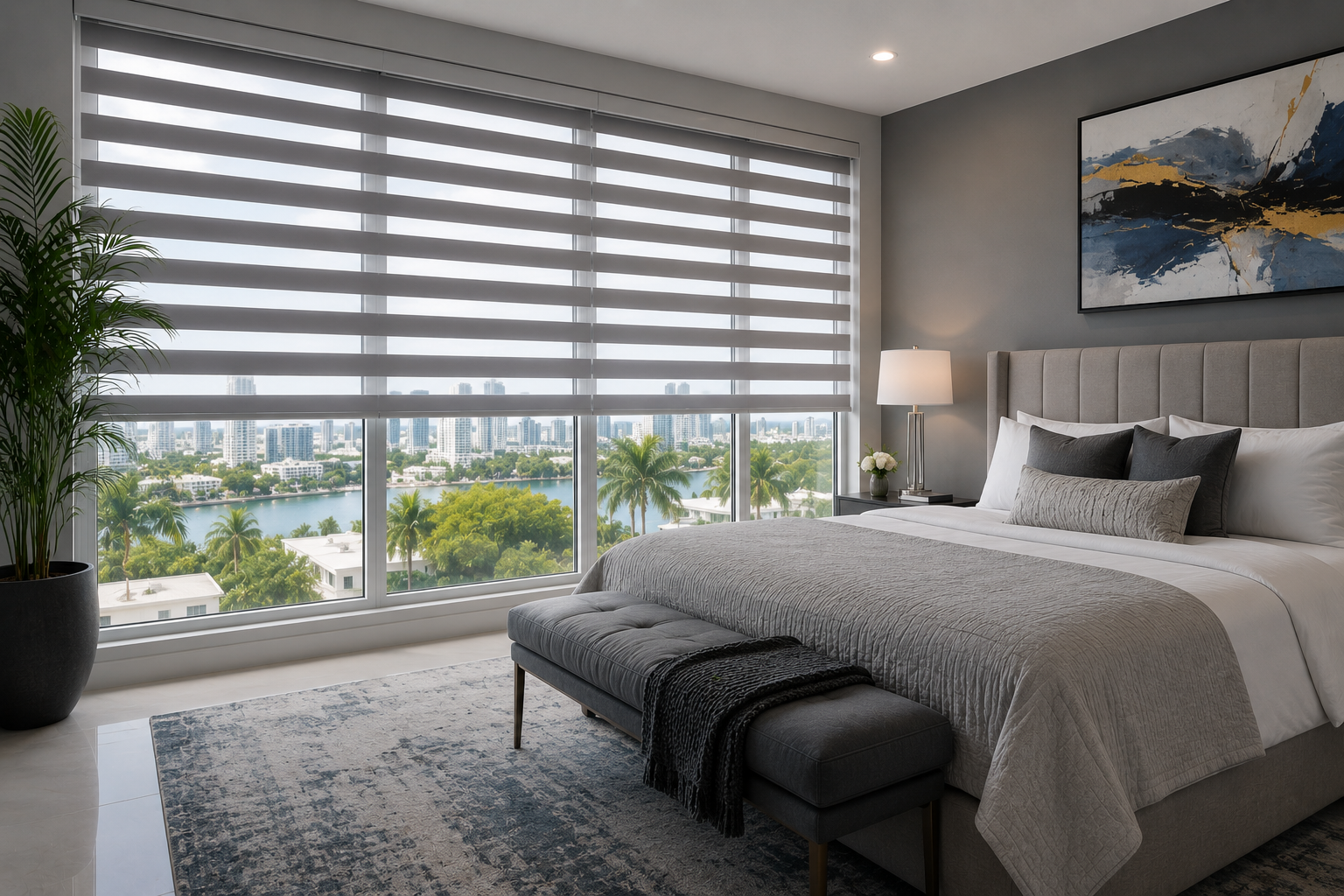
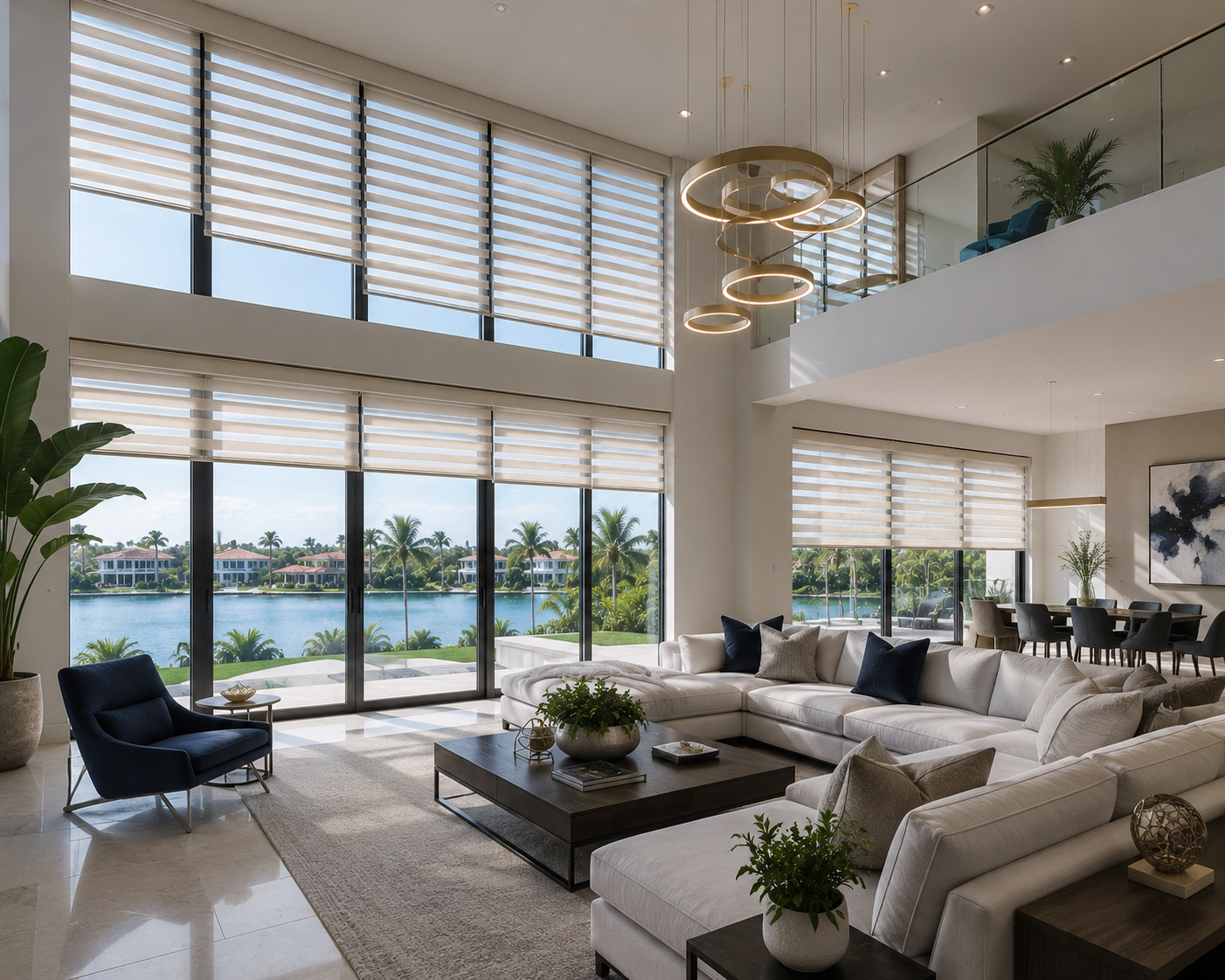
Recent zebra blinds projects
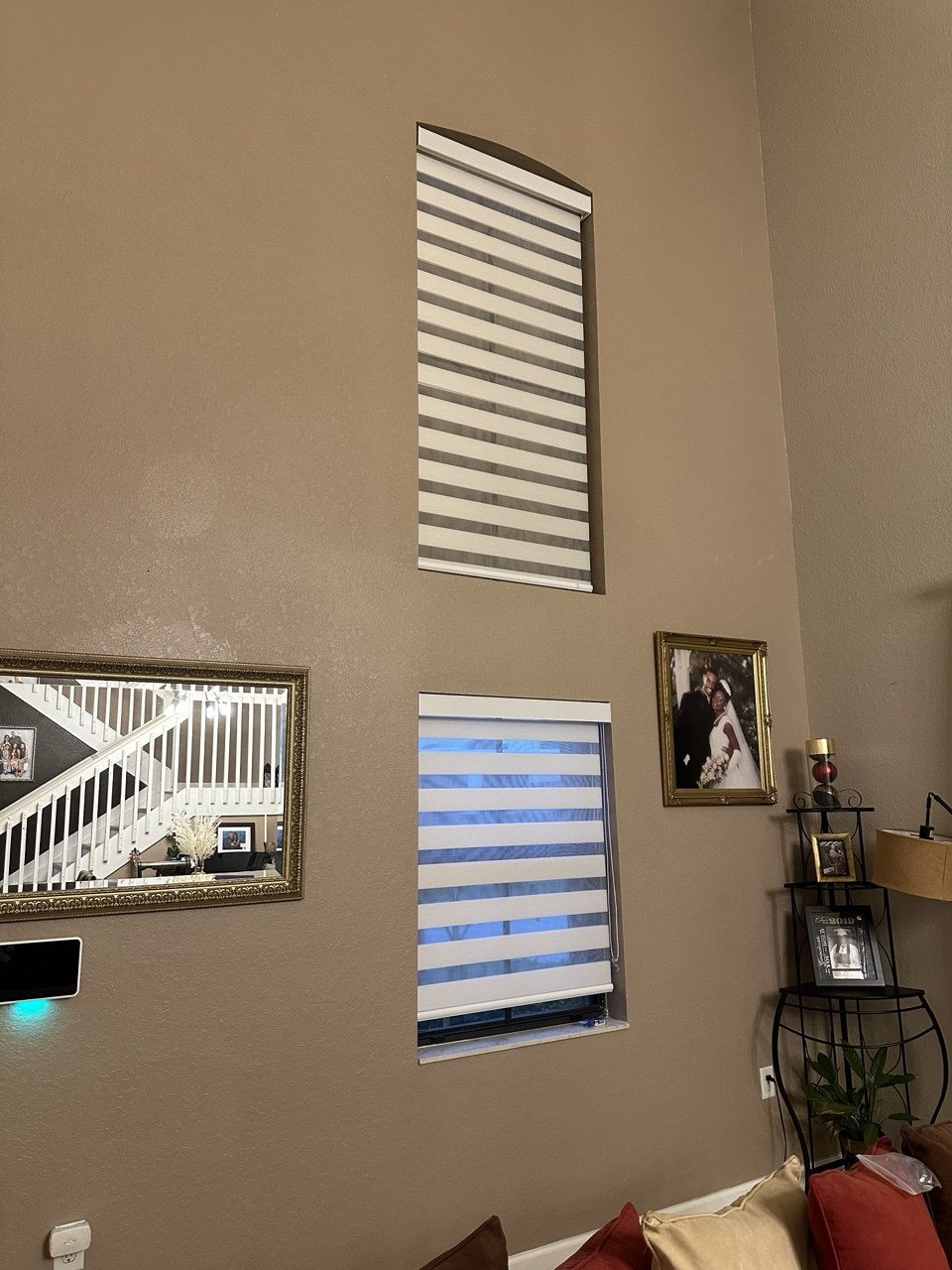
House · One motorized solar-powered shade, four manual chain-operated
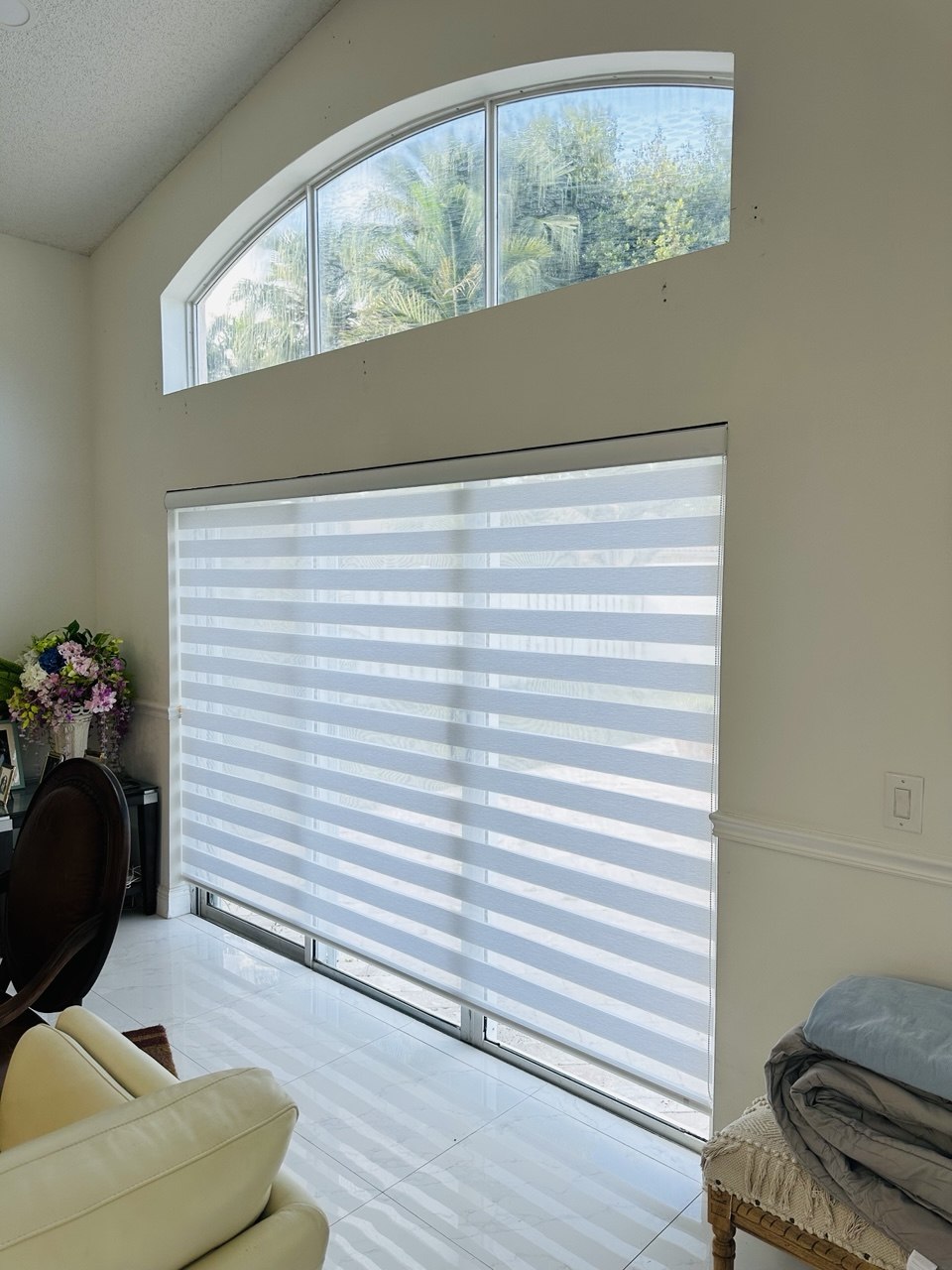
Zebra shades throughout a Kendall house
Five beige zebra shades fitted in a Kendall house, including one motorized solar-powered shade on a high arched window.
Zebra Blinds
Residential house · Manual
Custom Zebra and Roller Shades Fort Lauderdale
This Fort Lauderdale residential project included the installation of 8 custom window shades, combining zebra shades and roller shades across multiple rooms. The installation included a large living-area opening, bathroom windows, and additional room windows, with both installation-process and before-and-after photos documented.
Zebra Blinds, Roller Shades
Residential house · Motorized
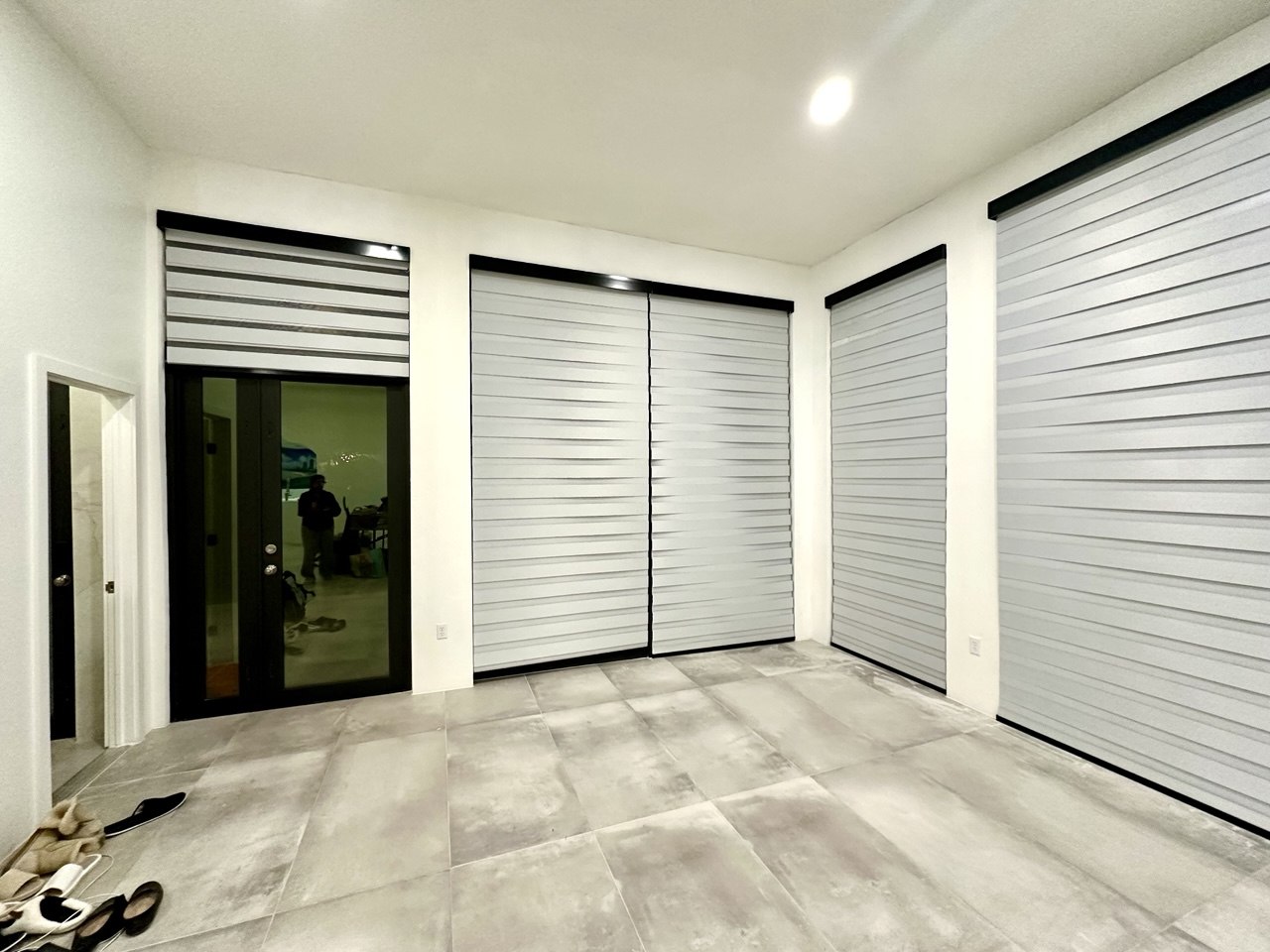
Custom Motorized Zebra Shades Fort Lauderdale
Seven custom motorized zebra shades up to 133 inches tall installed across large windows and glass doors in a Fort Lauderdale home.
Zebra Blinds
Residential home · Motorized and manual
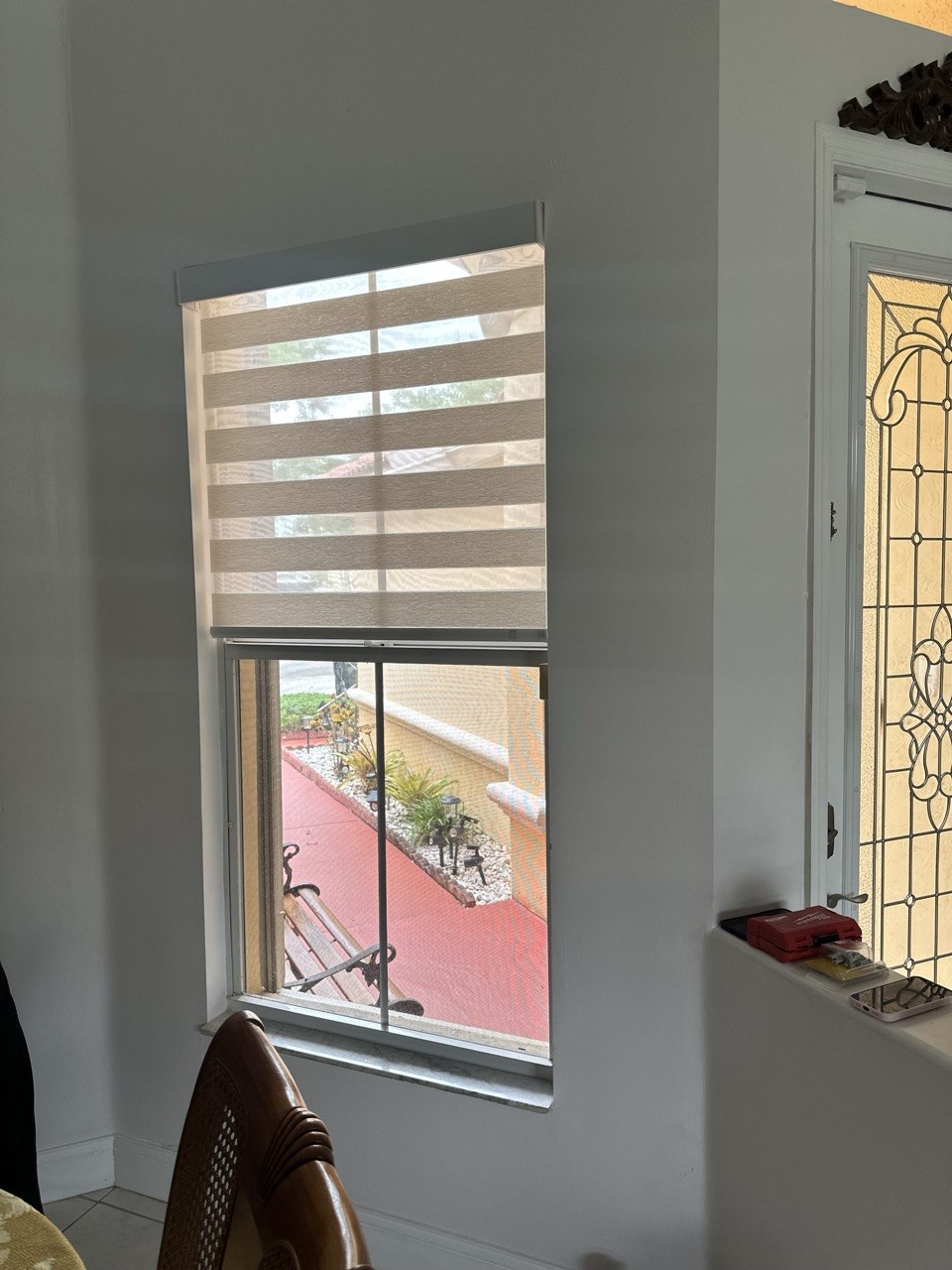
Motorized & Manual Zebra Shades in Hollywood, FL
We installed custom Zebra shades throughout this Hollywood, Florida home using both motorized and manual operation. The layered sheer-and-solid fabric allows the homeowner to adjust daylight and privacy while keeping a clean, modern appearance.
Zebra Blinds
Zebra Blinds installed near you
These are the markets we install zebra blinds in most often. We cover every city in Miami-Dade, Broward and Palm Beach — see the full service area list.
Other product lines
Clean, minimal shades in light-filtering, solar screen or blackout fabrics.
Shangri-La ShadesSoft fabric vanes suspended between sheer layers for elegant daylight, privacy and adjustable light control.
Cellular (Honeycomb) ShadesHoneycomb cells that trap air and cut cooling costs in the Florida heat.
Dual ShadesTwo shades on one bracket — solar screen by day, blackout by night.
Outside (Exterior) ShadesPatio and balcony shades that stop heat before it reaches the glass.
Roman ShadesSoft fabric folds that bring warmth and tailored texture to a room.
Drapery & CurtainsCustom drapery panels and curtains that soften a room and layer over any shade.
Free in-home measure across South Florida
Tell us the rooms and we'll bring samples, measure every opening and quote on the spot — no charge, no pressure.