Custom Drapery & Curtains in Miami and South Florida
Drapery is what finishes a room. Shades solve the light; panels solve the proportions — they carry the eye up, soften a hard opening, absorb sound and make a window look like part of the architecture rather than a hole in the wall. Every panel we supply is made to measure, so the hem lands where it should and the fullness is right for the fabric.
Why homeowners choose drapery & curtains
- Made-to-measure panels in linen, velvet, sheer and performance fabrics
- Ripple fold, pinch pleat, grommet and rod pocket headings
- Blackout or thermal lining for bedrooms and media rooms
- Motorized tracks that open and close on a schedule or by app
Frequently asked questions
Can drapery be combined with blinds or shades?
Yes — layering is the most popular option. A solar or blackout shade handles heat and privacy, while the drapery panels frame the window and finish the room.
Which drapery fabrics work best in South Florida?
Performance blends and faux linens hold their shape in high humidity and resist fading from strong sun far better than untreated natural linen or silk.
Fullness, heading and how a panel hangs
Fullness is the ratio of fabric width to the width it covers. A skimpy panel looks flat and rented; a properly full panel holds its folds whether it is open or closed. We specify fullness according to the fabric weight and the heading style rather than to a fixed rule.
The heading — the way the panel is pleated at the top — sets the character. Ripplefold and wave headings give a continuous, contemporary S-curve and work particularly well on tracks and on wide slider walls. Pinch, euro and inverted pleats are more traditional and suit rod-mounted panels in formal rooms. Grommet headings are casual and practical for panels that get pulled often.
Sheers, lining and blackout
An unlined sheer panel filters light and softens a window without providing privacy. Lining adds body, protects the face fabric from the sun and stops the panel from glowing at night. A blackout lining, where the fabric collection offers one, turns the panel into a genuine light barrier.
The most durable specification in South Florida is a layered one: a functional shade at the glass and a lined drapery panel in front. The shade takes the UV punishment and does the light control; the drapery stays clean, holds its colour and does the decorative work.
- Sheer panels for softness and daytime diffusion
- Privacy and dim-out linings for living areas and bedrooms
- Blackout linings where the fabric collection supports them
- Interlining for weight and drape on formal panels
Rods, tracks and motorized tracks
Decorative rods suit rod-pocket, grommet and pleated panels in rooms where the hardware is meant to be seen. Tracks — ceiling or wall mounted, and often recessed into a pocket — disappear entirely and give a much smoother draw, which is why they are the default on long slider walls.
Motorized drapery tracks are available and are worth specifying where a panel run is very long, very heavy, or behind furniture. As with all our motorized work, we confirm the specific system and its control options at the measure rather than promising a configuration in advance.
Fabrics that survive the Florida sun
Strong, near-year-round sun and high humidity are hard on textiles. Performance blends and faux linens hold their shape and resist fading far better than untreated natural linen or silk, which can stretch in humidity and degrade in direct sun.
Where a client wants a natural fibre, we recommend lining it and, if the window is heavily exposed, layering it behind a solar shade so the panel is protected from direct exposure.
How drapery & curtains compare
Drapery vs roman shades
Both are soft treatments. Drapery needs wall space beside the window for the stack and covers more of the room; a roman lives in the opening. Where the wall return is narrow or furniture sits tight to the glass, the roman is the practical choice.
Drapery vs blinds and shades alone
Shades control light; drapery controls how the room feels. On a large opening the two are complementary rather than alternative, and the most successful rooms we install use both.
Sheer drapery vs Shangri-La shades
A sheer panel softens the whole wall but is not adjustable. Shangri-La gives adjustable privacy in the plane of the window itself. Where the client wants softness plus control, the answer is often a Shangri-La shade with drapery panels at the sides.
Rooms and applications
Living rooms and great rooms
Full-height panels on a ceiling track make an eight-foot window read as a full wall of glass and absorb a noticeable amount of echo in a hard-surfaced room.
Primary bedrooms
Lined or blackout panels over a blackout shade — the shade does the darkness, the drapery kills the edge light and finishes the room.
Sliding glass doors
A track-mounted panel run with a stack-back position that leaves the active door leaf clear, so the drapery never blocks the way outside.
Dining and formal rooms
Pleated panels on decorative hardware, often with a roman shade behind, for rooms where the window is part of the decoration.
How to measure for drapery & curtains
Drapery measurement is about the wall, not the window. Where the rod or track goes, how far the panels stack back, and where the hem lands are all decisions taken before any fabric is cut.
- Measure the full opening width, then the wall available on each side for the stack-back — this is what decides how much glass the open panels will cover.
- Measure the drop from the intended rod or track height to the floor, at several points across the width; floors in older South Florida homes are rarely level.
- Decide the hem: floor-clearing, just kissing the floor, or a deliberate break. This must be settled before fabrication.
- Confirm the mounting surface at the head — ceiling, wall or a recessed pocket — and check for structure to fix into.
- On sliders, plan the stack so the active leaf is never blocked and so the panels clear the door handle.
- Where drapery layers over a shade, confirm the projection needed so the panel hangs clear of the shade's bottom rail.
DIY measurements are useful for planning and preliminary estimates. Final measurements for custom-made window treatments should be verified professionally before production — see our measuring guide or book a free professional measurement.
Professional installation
- 1.Rod or track height and stack-back positions are marked and checked against the measured plan before drilling.
- 2.Hardware is fixed into structure, levelled across the full run, and checked for smooth carrier travel.
- 3.Panels are hung, the drop confirmed against the floor at several points and adjusted where the floor falls away.
- 4.Folds are dressed and tied for the first period so the panel trains into an even wave.
- 5.Motorized tracks have their limits set and controls paired and tested with the panels loaded.
Care and cleaning
- Vacuum panels on low suction with an upholstery attachment; dust is what dulls a fabric first.
- Follow the fabric's cleaning instructions — most lined and interlined panels are dry-clean only.
- Re-dress the folds after cleaning and leave them tied for a few days so the wave returns.
Helpful guides
Often compared with
Recent drapery & curtains projects
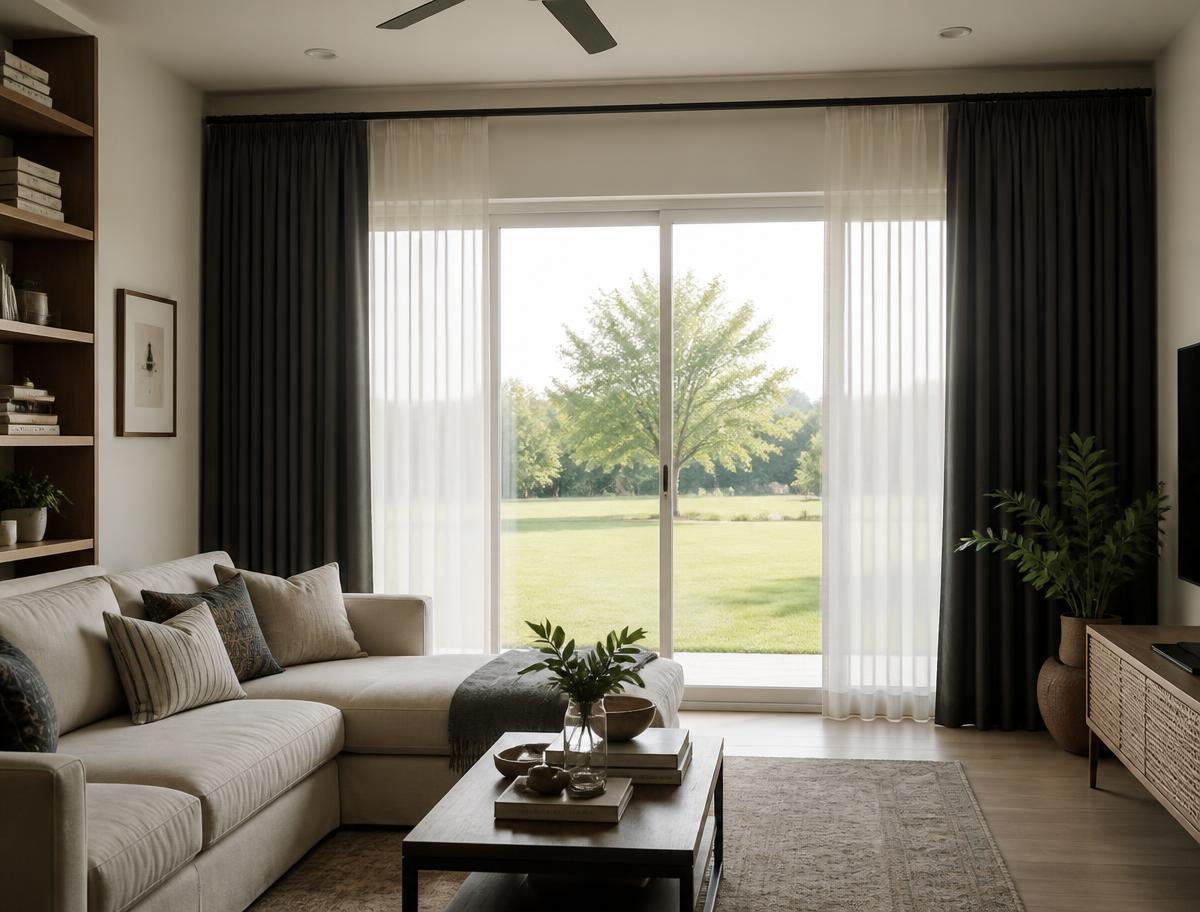
We publish project pages only from installations we actually completed, with the real city, fabric and control type. Photos from recent Drapery & Curtains projects jobs are added as each record is finalised.
Drapery & Curtains installed near you
These are the markets we install drapery & curtains in most often. We cover every city in Miami-Dade, Broward and Palm Beach — see the full service area list.
Other product lines
Alternating sheer and solid bands that switch from soft daylight to privacy in one pull.
Roller ShadesClean, minimal shades in light-filtering, solar screen or blackout fabrics.
Shangri-La ShadesSoft fabric vanes suspended between sheer layers for elegant daylight, privacy and adjustable light control.
Cellular (Honeycomb) ShadesHoneycomb cells that trap air and cut cooling costs in the Florida heat.
Dual ShadesTwo shades on one bracket — solar screen by day, blackout by night.
Outside (Exterior) ShadesPatio and balcony shades that stop heat before it reaches the glass.
Roman ShadesSoft fabric folds that bring warmth and tailored texture to a room.
Free in-home measure across South Florida
Tell us the rooms and we'll bring samples, measure every opening and quote on the spot — no charge, no pressure.